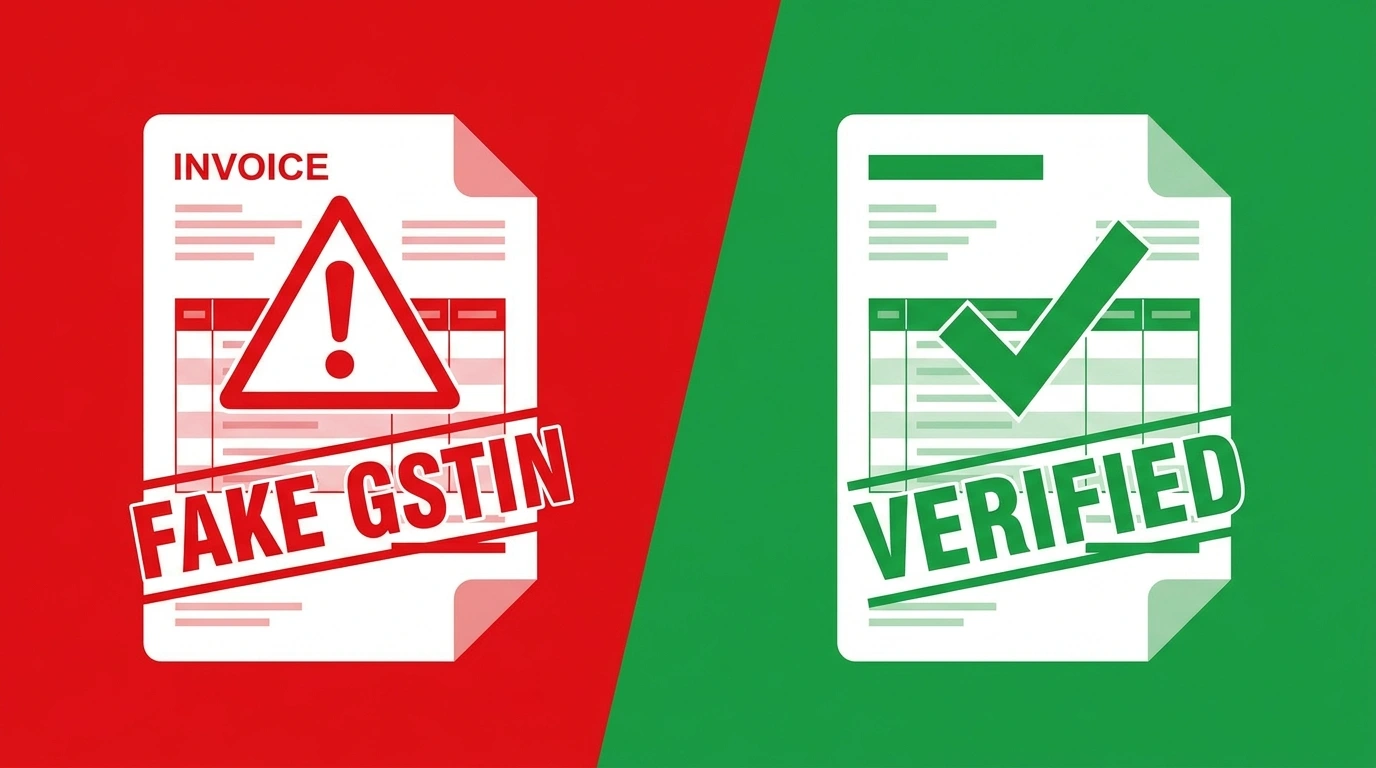
A Surat Textile Trader Lost ₹18 Lakh Because of One Unverified Invoice
He had been buying fabric from the same supplier for three months. The invoices looked perfectly normal GSTIN printed at the top, tax breakdown clearly shown, GST collected on every bill.
When a GST officer knocked on his door in February 2026, he found out the GSTIN on those invoices belonged to a cancelled firm that had shut down in 2023. The actual supplier had been collecting GST, pocketing it, and never filing a return. Every rupee of ITC this trader had claimed across those three months ₹18.3 lakh was reversed on the spot.
Interest at 24% per annum started ticking from the date of each original claim.
The trader had no idea. He had never once checked the GSTIN.
This happens to hundreds of businesses every month across India. The check takes 30 seconds. The cost of skipping it can be lakhs of rupees.
Why This Problem Is Getting Worse, Not Better
India's GST system generates over 10 crore invoices every single month. In FY 2025-26, CBIC's enforcement wing DGGI detected fake ITC fraud cases worth over ₹57,000 crore in a single year. Thousands of shell companies are created specifically to issue invoices, collect GST from buyers, and never deposit a paisa with the government.
The businesses who suffer most are not the fraudsters they shut down and disappear. It is the buyers who paid the invoices in good faith, claimed ITC in their GSTR-3B, and now face reversal demands with interest.
Section 16(2)(c) of the CGST Act is clear: you can claim ITC only if the supplier has actually paid the corresponding tax to the government. If they have not whether they are a fraudster or just a non-filer your ITC is invalid. The law does not care that you did not know.
There is only one way to protect yourself: verify before you pay.
The 5 Checks Each Takes Under 30 Seconds
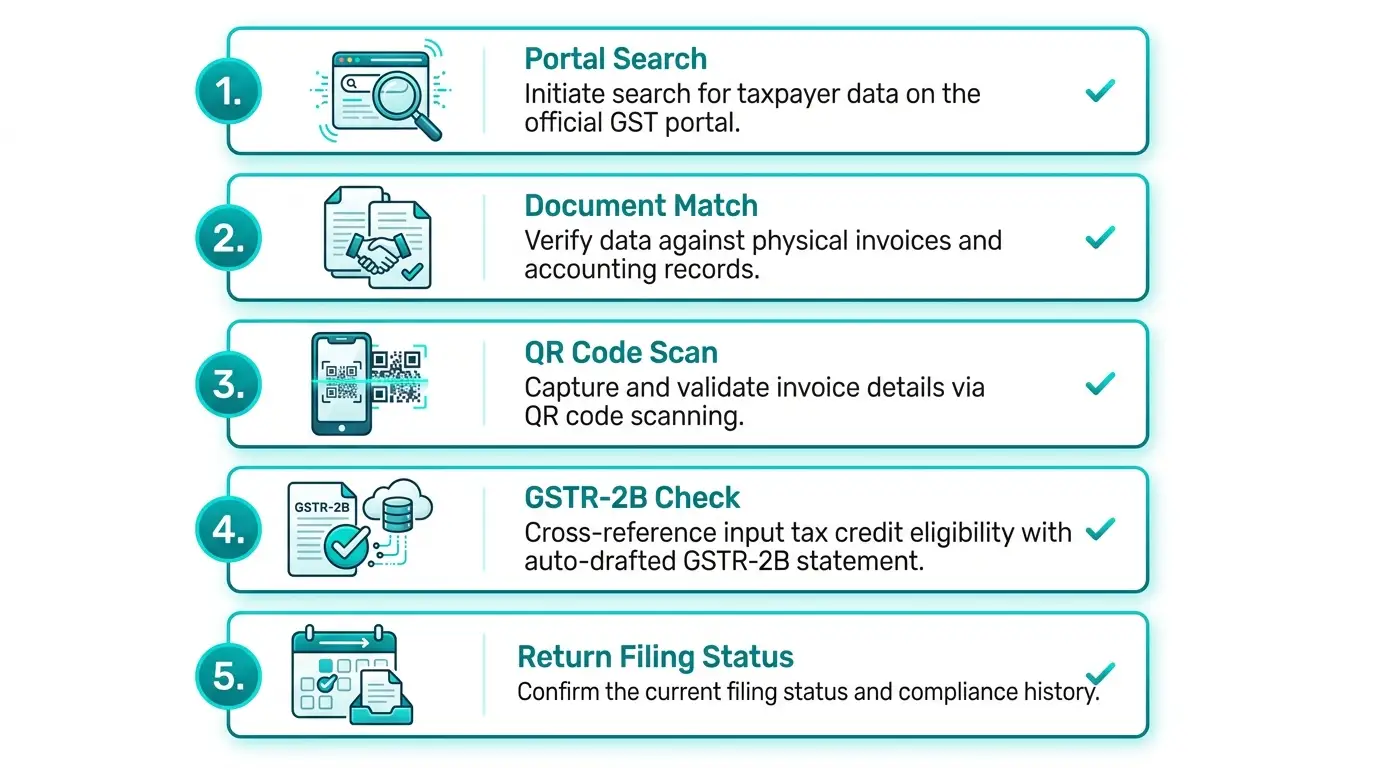
Check 1 Is the GSTIN Even Valid? (Portal Search)
This is the most basic check and the one most businesses skip.
Go to gst.gov.in → Search Taxpayer → Search by GSTIN/UIN.
Enter the 15-digit GSTIN from the invoice. In 5 seconds, the portal tells you:
Whether the GSTIN exists
The legal name of the registered business
Principal place of business
Registration status Active, Suspended, or Cancelled
What to look for:
The name on the GST portal must match the name on the invoice exactly (or close enough to rule out a typo). If the portal shows "Cancelled" stop the transaction immediately. If it shows "Suspended" treat it as a red flag and verify with your supplier before proceeding.
Or use the SmartGST GSTIN Validator same check, faster interface, no navigation required. For multiple vendors at once, use the Bulk GSTIN Validator to verify up to 50 GSTINs simultaneously.
Red flag: GSTIN exists on the portal but the business name does not match what the supplier told you. This is a common fraud pattern fraudsters sometimes use a real GSTIN belonging to a completely different business.
Check 2 Does the Invoice Appear in Your GSTR-2B?
If a supplier issues an invoice in your name but never files GSTR-1 or never reports that invoice, it will not appear in your GSTR-2B. And if it is not in your GSTR-2B, you cannot claim ITC on it.
After the 14th of every month, log into GST portal → Services → Returns → GSTR-2B. Search for the supplier's GSTIN and verify that the invoices you received are listed there.
An invoice missing from GSTR-2B can mean:
The supplier has not filed GSTR-1 yet (may file later)
The supplier never reported this specific invoice
The invoice is fake and no corresponding GSTR-1 entry exists anywhere
If a supplier's invoices consistently do not appear in your GSTR-2B month after month, that is not a portal error. That is a non-compliant supplier. Stop buying from them or stop claiming ITC until the issue is resolved.
Use the SmartGST GSTR-2B Reconciliation Tool to cross-check your purchase register against GSTR-2B in one step.
Check 3 Scan the QR Code on E-Invoices
If your supplier has annual turnover above ₹5 crore, they are required to generate e-invoices through the IRP (Invoice Registration Portal). Every valid e-invoice carries:
An IRN (Invoice Reference Number) a unique 64-character hash
A digitally signed QR code
Scan the QR code on the invoice using any QR scanner or the NIC e-Invoice verification app. The decoded QR code shows the supplier GSTIN, buyer GSTIN, invoice number, date, taxable value, and GST amount exactly as registered on the IRP.
If the scanned data does not match what is printed on the invoice, the invoice has been tampered with. If the QR code does not scan, the invoice may not be a genuine e-invoice at all.
This check is non-negotiable for high-value invoices. A ₹50 lakh purchase invoice without a verifiable QR code from an e-invoice-eligible supplier is a red flag that must be investigated.
Check 4 Verify the Supplier Is Actually Filing Returns
A GSTIN can be Active on the portal technically valid while the business behind it has not filed a single GST return in six months. This is the scenario that traps buyers most often. The GSTIN exists, the supplier appears registered, but no tax is actually being deposited.
On the GST portal: Search Taxpayer → Enter GSTIN → Click on the GSTIN in results → Check "Returns Filing Status."
You can see which months the supplier filed GSTR-1 and GSTR-3B. If they have not filed for the last 2–3 months, your ITC from their invoices in those months is at risk even if the GSTIN shows Active.
A supplier who is not filing returns is collecting GST from you but not remitting it to the government. Your ITC claim is valid only if their tax has been paid. If it has not, Section 16(2)(c) will be applied against you when the department runs its analytics.
Check 5 Cross-Check Invoice Details Against GSTIN Structure
A 15-digit GSTIN has a specific structure that is publicly documented:
Digits 1-2:   State code (e.g., 27 for Maharashtra, 07 for Delhi)
Digits 3-12:  PAN of the registered entity
Digit 13:     Entity number (1 for first registration)
Digit 14:     Default "Z"
Digit 15:     Check digit (calculated)
If your supplier is based in Gujarat (state code 24) but the GSTIN on the invoice starts with 27 (Maharashtra), that is a structural mismatch. Either the invoice is fake or the supplier is registered in a different state than claimed.
You do not need to manually decode this. The SmartGST GSTIN Validator does the structural check automatically and flags any state-code or format mismatches.
The Penalty You Are Trying to Avoid
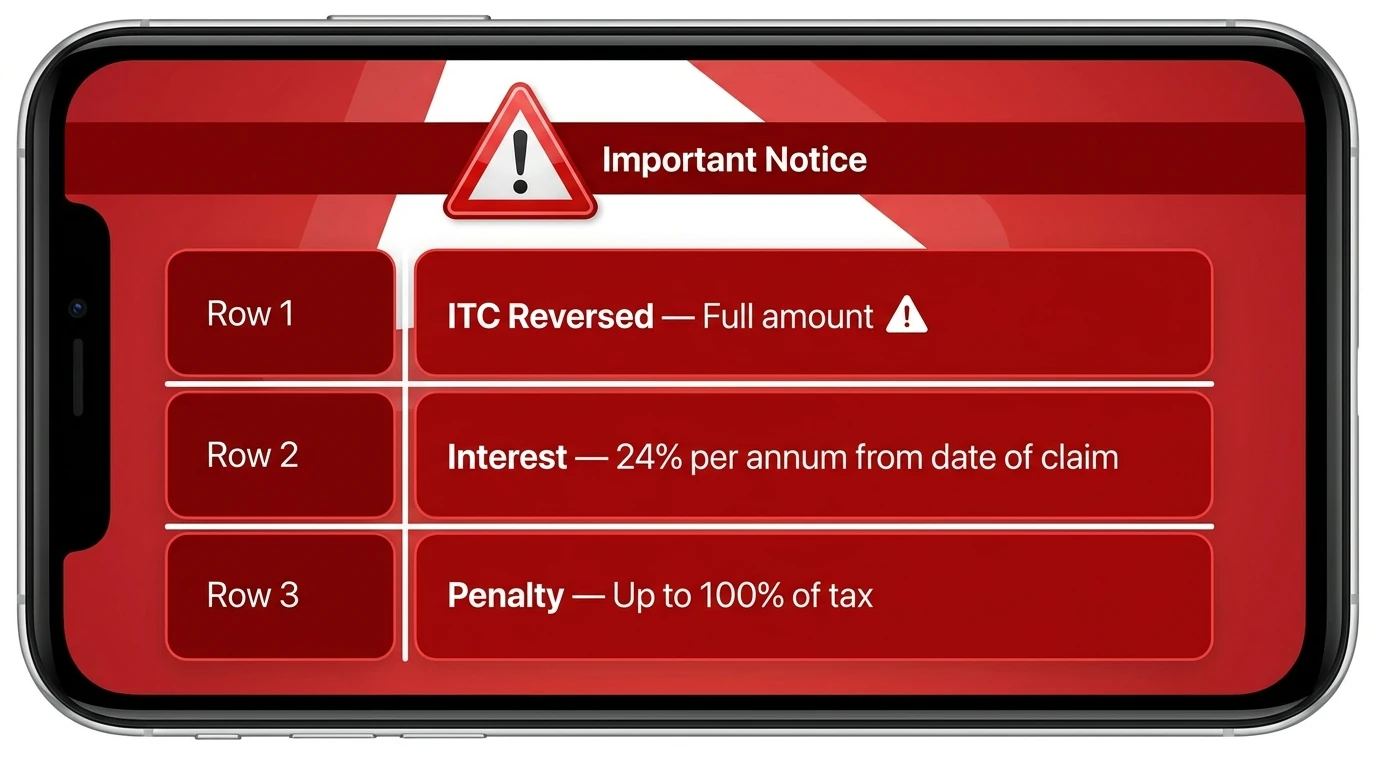
Understanding what is at stake makes the 30-second verification feel less optional.
What Happens | Amount |
|---|---|
ITC reversed | Full amount claimed on fake invoice |
Interest | 24% per annum from date of original claim |
Penalty (Section 74) | Up to 100% of tax if fraud is established |
Criminal liability (Section 132) | Imprisonment up to 5 years for claims above ₹5 crore |
The 24% interest is the one that quietly destroys businesses. If you claimed ₹10 lakh in ITC from a fake supplier in April 2025 and the notice comes in April 2026, you owe ₹10 lakh in reversed ITC plus ₹2.4 lakh in interest plus penalty on top.
The notice does not care that you believed the supplier was genuine. Section 16(2)(c) makes buyer due diligence a legal obligation, not a courtesy.
Red Flags That Should Stop Any Payment Immediately
Beyond the five checks, train your accounts team to watch for these patterns:
Structural red flags:
Invoice has no HSN or SAC code (mandatory for B2B invoices above ₹50,000)
GST amount does not mathematically match taxable value × rate
Invoice serial numbers are not sequential or restart without explanation
Supplier cannot provide a delivery challan or e-Way Bill for goods transactions
Supplier behavior red flags:
Supplier insists on cash payment despite the transaction size
Supplier cannot provide their GST registration certificate on request
Supplier's business address on the invoice does not match GST portal records
Supplier has been operating for less than 6 months with unusually high invoice volumes
ITC pattern red flags:
Your ITC utilization consistently exceeds 95% of your output tax liability (this triggers automatic GSTN flags)
ITC is being claimed on purchases that have no correlation with your actual business outputs
Multiple suppliers sharing the same registered address, phone number, or email on the GST portal
What to Do If You Discover a Fake Invoice After Paying
First, stop claiming ITC on any further invoices from this supplier.
Second, reverse the ITC already claimed voluntarily in your next GSTR-3B filing. Voluntary reversal before a notice arrives significantly reduces your penalty exposure from up to 100% of tax to as low as 15% if you self-correct before proceedings begin.
Third, file a complaint with your jurisdictional GST officer. Under the GSTN system, authorities can flag the supplier's GSTIN as a fraudulent entity, which triggers alerts for other taxpayers who may have received invoices from the same source.
Fourth, if you have received a formal notice (Form ASMT-10 or DRC-01), use the SmartGST GST Notice Reply Generator to draft a structured response that documents your due diligence and timeline.
Build a Vendor Verification SOP One That Takes 2 Minutes Per New Supplier
Rather than checking every invoice every month, the most efficient approach is a one-time verification for each new supplier when they are onboarded, with periodic re-checks for regular suppliers.
New supplier onboarding checklist:
Verify GSTIN on portal Active status, name match, address match
Confirm GSTIN structure state code matches claimed location
Check return filing status at least 3 consecutive months of GSTR-3B filed
Request GST registration certificate (Form REG-06)
Confirm they are e-invoice eligible and verify one sample invoice QR code
Monthly check for existing regular suppliers:
Verify GSTIN status is still Active (not Suspended or Cancelled)
Confirm GSTR-2B shows their invoices for the current month
Flag any supplier whose invoices stop appearing in GSTR-2B
This entire workflow, done properly, adds about 2 minutes per new vendor and 5 minutes per month for your entire supplier base if you use the Bulk GSTIN Validator.
The Tools That Make Verification Fast
GSTIN Validator ➡️ Enter any GSTIN and get Active/Suspended/Cancelled status plus structural verification instantly. No login required.
Bulk GSTIN Validator ➡️ Paste up to 50 supplier GSTINs at once. Best for monthly vendor re-verification or new supplier onboarding batches.
GST Registration Status Checker ➡️ Detailed GSTIN lookup with registration date, business type, and current status. Useful for deep verification of high-value suppliers.
GSTR-2B Reconciliation Tool ➡️ Cross-check your purchase register against GSTR-2B. The fastest way to identify which supplier invoices are missing from the system a key fake invoice signal.
ITC Eligibility Checker ➡️ Before claiming ITC on any purchase, verify it qualifies under Section 17(5) rules.
GST Notice Reply Generator ➡️ If you have already received a notice for ITC claimed on an invalid invoice, use this to draft your response documenting due diligence.
Related Guides
GST Invoice Management System (IMS) Complete Guide 2026 ➡️ IMS is your second line of defence against fake invoices. Rejecting a suspicious invoice in IMS before GSTR-3B filing is cleaner than a post-notice reversal.
How to Check and Respond to a GST Notice ➡️ If a fake supplier invoice has already triggered a scrutiny notice, start here.
How to Claim a GST Refund ➡️ If you have voluntarily reversed ITC on a fake invoice, you may be entitled to a refund of the original tax paid on those purchases.
GSTAT Appeal Deadline 30 June 2026 ➡️ If a fake invoice demand order has gone through the first appeal stage, GSTAT is your next option.
GST Late Fee and Penalty Guide 2026 ➡️ Full breakdown of penalty structure for ITC fraud and how voluntary disclosure reduces your exposure.
References
Section 16(2)(c), CGST Act, 2017 Conditions for ITC eligibility (supplier tax payment requirement)
Section 74, CGST Act, 2017 Penalty for fraud and willful misstatement
Section 132, CGST Act, 2017 Offences and penalties including imprisonment
CBIC Circular on Fake Invoice Fraud Prevention, 2024
DGGI Annual Report FY 2025-26 Fake ITC detection statistics ₹57,000 crore
GSTN Technical Guide GSTIN Structure and Check Digit Calculation
NIC e-Invoice Portal IRN and QR Code Verification einvoice6.gst.gov.in
GST Council Directive on Offence Database Creation for Flagged GSTINs, 2025
30 Seconds Today. Lakhs of Rupees Saved Tomorrow.
The Surat trader from the opening of this article is not unique. His story plays out in hundreds of GST audits every month across India. The difference between him and businesses that avoid this outcome is not luck it is a 30-second check that has become second nature.
Get every GST update, advisory, and compliance deadline explained in plain English the day it happens:
Content verified against Section 16(2)(c) of CGST Act, 2017, and CBIC Circular on Fake Invoice Fraud. Last updated: 8 June 2026. For specific ITC dispute advice, consult a qualified CA or tax practitioner.