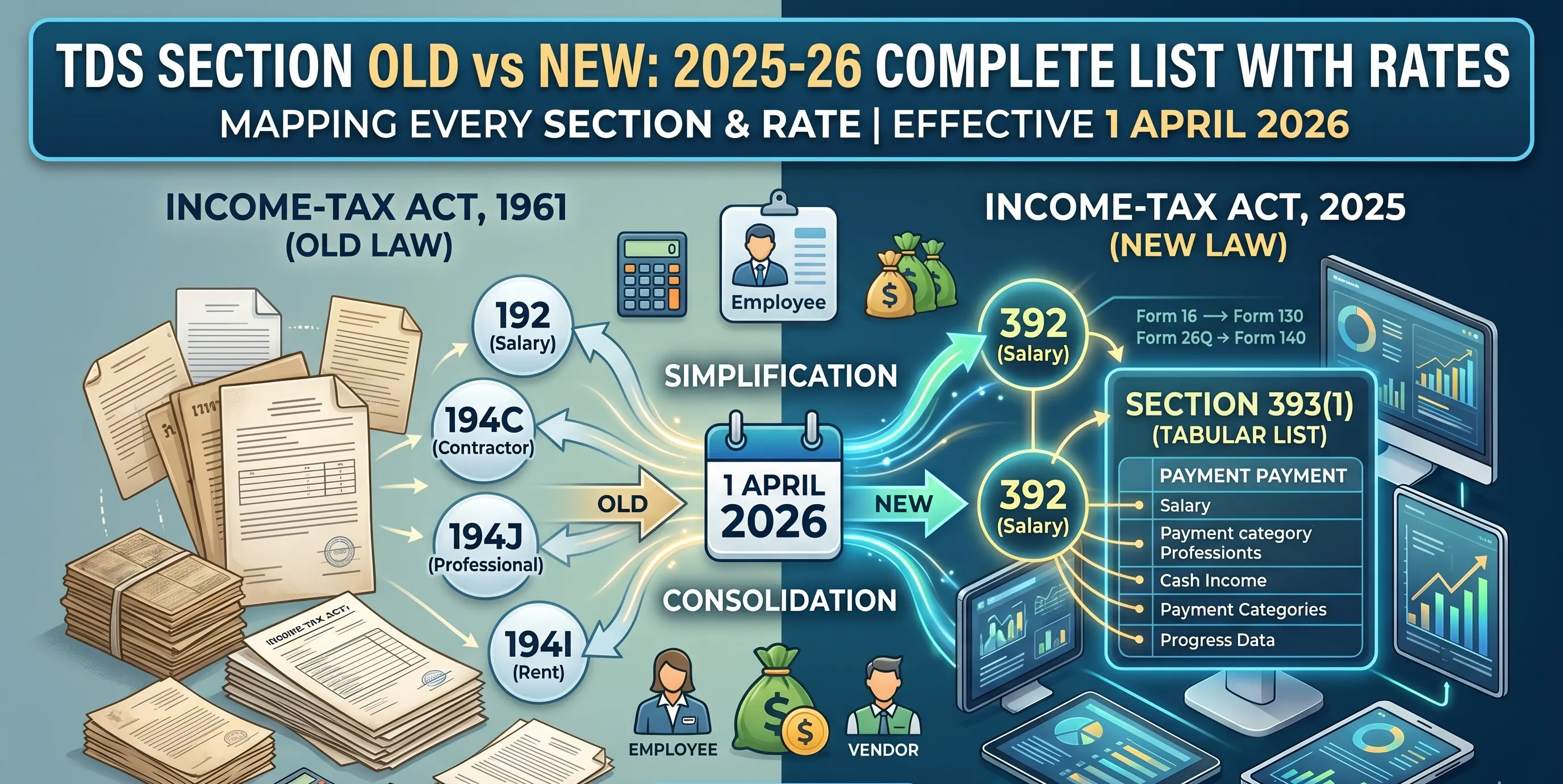
TDS Section Old vs New: The Complete 2025-26 List With Rates
If you searched for "TDS section old vs new," you are probably staring at a payment, a return, or a Form 16 with a section number you do not recognise anymore. You are not alone. Every TDS section under the Income-tax Act, 1961, from Section 192 on salary to Section 194S on virtual digital assets, has been replaced by a new section number under the Income-tax Act, 2025, effective 1 April 2026. This guide is the complete, verified mapping: every old section next to its new equivalent, with the rate and threshold that applies right now.
We built this page because the existing search results for this query are either incomplete, outdated, or buried inside long compliance articles you have to scroll through to find one number. Here, the table comes first.
Quick Answer: What Changed in TDS Sections
The Income-tax Act, 2025 replaced the scattered TDS sections of the old law (192, 193, 194, 194A through 194T) with two consolidated provisions. Section 392 now covers TDS on salary, replacing the old Section 192. Section 393(1) covers every other category of TDS on payments to residents, organised as a single table with serial numbers instead of separate alphabetic sections. The rates and threshold limits have largely stayed the same. What changed is the section number you quote, the form number you file, and the structure of the law itself.
Key Facts Table
Item | Detail |
|---|---|
Old law name | Income-tax Act, 1961 |
New law name | Income-tax Act, 2025 |
New law effective date | 1 April 2026 (Tax Year 2026-27 onwards) |
Old law still applies to | FY 2025-26 and all earlier years, including any sum credited or paid up to 31 March 2026 |
Salary TDS, old section | Section 192 |
Salary TDS, new section | Section 392 |
Non-salary TDS, old sections | 193, 194, 194A to 194T (multiple separate sections) |
Non-salary TDS, new section | Section 393(1), a single consolidated table |
Trigger event | Earlier of credit to payee's account or actual payment (date of payment only, for salary) |
Governing rule for transition | The Act in force on the date of the trigger event applies, not the date of filing |
How to Find Your TDS Section: Step by Step
Identify the nature of the payment. Is it salary, rent, professional fees, contractor payment, commission, interest, or something else? This determines which row of the old or new table applies to you.
Check the date of the trigger event. For salary, this is the date of actual payment. For every other payment, it is whichever happens first: the date you credit the amount to the payee's account in your books, or the date you actually pay it.
Apply the law in force on that date. If the trigger event fell on or before 31 March 2026, use the old section number from the Income-tax Act, 1961. If it falls on or after 1 April 2026, use the new section number from the Income-tax Act, 2025.
Look up the matching section in the table below. Match the old section to its new equivalent and confirm the current rate and threshold.
Quote the correct section on your return, certificate and challan. Old-period corrections still go under the 1961 Act framework even after the new law commences. New-period filings must use the new section and the new form number.
Cross-check with our TDS Section Finder if you want an instant answer instead of working through the table manually. Enter the payment type and the date, and the tool returns the applicable section, rate and form.
Worked Example
Suppose your company pays a graphic designer (an individual, not a company) a professional fee of ₹80,000 for work delivered in March 2026, and the invoice is credited to her account in your books on 29 March 2026, with actual payment made on 6 April 2026.
Because the trigger event (credit) happened on 29 March 2026, which is before 1 April 2026, the old Act applies. You deduct TDS under Section 194J of the Income-tax Act, 1961, at 10% (professional fees), since the threshold of ₹50,000 has been crossed. TDS deducted = ₹8,000. This amount must be deposited by 30 April 2026 (the special non-government deductor deadline for March deductions), and reported in the old Form 26Q for Q4 FY 2025-26, due by 31 May 2026.
Now compare this to a near-identical case: the same fee, but the invoice is credited to her account on 2 April 2026 instead. Here the trigger event falls after 1 April 2026, so the new Act applies. You now quote Section 393(1), Sl. No. 6(iii) of the Income-tax Act, 2025, the rate stays 10%, but you deposit by 7 May 2026 and report it in the new Form 140 for Q1 Tax Year 2026-27, due by 31 July 2026.
The rate did not change. The threshold did not change. Only the section number, the deposit date, and the form number changed, because the trigger event crossed the 1 April 2026 boundary.
The Complete TDS Section Mapping Table
This is the core reference. Every common TDS category, old section next to new, with the current rate and threshold for FY 2025-26 / Tax Year 2026-27.
Payment Category | Old Section (Act, 1961) | New Section (Act, 2025) | Rate | Threshold |
|---|---|---|---|---|
Salary | 192 | 392 | Slab rate | Basic exemption limit |
Interest on securities | 193 | 393(1) Sl. No. 5(i) | Rates in force | ₹10,000 |
Dividend | 194 | 393(1) Sl. No. 7 | 10% | Nil |
Bank / post office / co-op interest | 194A | 393(1) Sl. No. 5(ii) | Rates in force | ₹1,00,000 (senior citizen) / ₹50,000 (others) |
Other interest (non-banking) | 194A | 393(1) Sl. No. 5(iii) | Rates in force | ₹10,000 |
Contractor payments | 194C | 393(1) Sl. No. 6(i) | 1% (individual/HUF payee) / 2% (others) | ₹30,000 per payment, ₹1,00,000 aggregate |
Insurance commission | 194D | 393(1) Sl. No. 1(i) | Rates in force | ₹20,000 |
Life insurance policy payout | 194DA | 393(1) Sl. No. 8(i) | 2% | ₹1,00,000 |
Commission / brokerage (non-insurance) | 194H | 393(1) Sl. No. 1(ii) | 2% | ₹20,000 |
Rent (non-specified person) | 194I | 393(1) Sl. No. 2(i) | 2% (plant/machinery) / 10% (land/building) | ₹50,000 per month |
Rent by specified individual/HUF | 194IB | 393(1) Sl. No. 2(ii) | 2% (plant/machinery) / 10% (land/building) | ₹50,000 per month |
Transfer of immovable property | 194IA | 393(1) Sl. No. 3(i) | 1% of higher of consideration or stamp duty value | ₹50 lakh |
Mutual fund / specified unit income | 194K | 393(1) Sl. No. 4(i) | 10% | ₹10,000 |
Compensation on compulsory acquisition | 194LA | 393(1) Sl. No. 3(iii) | 10% | ₹5,00,000 |
Business trust distribution | 194LBA | 393(1) Sl. No. 4(ii) | 10% | Nil |
Investment fund income | 194LBB | 393(1) Sl. No. 4(iii) | 10% | Nil |
Securitisation trust income | 194LBC | 393(1) Sl. No. 4(iv) | 10% | Nil |
Individual/HUF contractor/professional/commission | 194M | 393(1) Sl. No. 6(ii) | 2% | ₹50,00,000 |
E-commerce operator payments | 194O | 393(1) Sl. No. 8(v) | 0.1% of gross sale/service value | Nil |
Specified senior citizen income | 194P | 393(1) Sl. No. 8(iii) | Rates in force | As applicable |
Purchase of goods above ₹50 lakh | 194Q | 393(1) Sl. No. 8(ii) | 0.1% | Amount exceeding ₹50,00,000 |
Benefit or perquisite from business | 194R | 393(1) Sl. No. 8(iv) | 10% | ₹20,000 |
Professional / technical fees, royalty | 194J | 393(1) Sl. No. 6(iii) | 2% (FTS, royalty for films, call centre) / 10% (others) | ₹50,000 (most categories) |
Transfer of Virtual Digital Asset | 194S | 393(1) Sl. No. 8(vi) | 1% | Nil |
Where the table shows "Rates in force," the operative percentage is not a fixed figure in the section itself. It is determined by the relevant Finance Act for the year, so always cross-check the current Finance Act before deducting.
TDS Forms: Old Number vs New Number
It is not just sections that changed. Every TDS return and certificate now carries a new form number too. Filing the old form for a Tax Year 2026-27 transaction, or vice versa, will get rejected at the portal level.
Purpose | Old Form | New Form |
|---|---|---|
Salary TDS return | Form 24Q | Form 138 |
Non-salary TDS return | Form 26Q | Form 140 |
Non-resident TDS return | Form 27Q | Form 144 |
TCS return | Form 27EQ | Form 143 |
Salary TDS certificate | Form 16 | Form 130 |
Non-salary TDS certificate | Form 16A | Form 131 |
Lower / nil deduction certificate | Form 13 | Form 128 |
TDS exemption declaration (replaces 15G/15H) | Forms 15G and 15H | Form 121 |
Why the Section Numbers Changed at All
The Income-tax Act, 1961, had been amended so many times over six decades that its TDS provisions were scattered across more than 20 separate sections, each with its own provisos, explanations and cross-references. Section 194 alone had sub-clauses bolted on over different Finance Acts. The Income-tax Act, 2025, was drafted to present the same substantive rules in a cleaner, tabular format. Instead of reading through 194A, 194C, 194D, 194H, 194I and a dozen others separately, you now read one table under Section 393(1) with serial numbers for each category. The total number of sections in the Act dropped from 819 to 536, and the number of forms nearly halved, from 399 to 190. This was a drafting and structural simplification, not a change in tax policy. Rates and thresholds were carried forward almost unchanged.
Practical Mistakes to Avoid During the Transition Year
Quoting the old section for a Tax Year 2026-27 payment. If you credit or pay an amount on or after 1 April 2026, you must use the new Section 393(1) table reference, not the old section number, even if your accounting software still shows the old labels out of habit.
Filing corrections for old periods under new forms. Correction statements for Q1 to Q4 of FY 2025-26 or any earlier year must still be filed under the old Income-tax Act, 1961 framework, using the old forms 24Q, 26Q or 27Q, even after 1 April 2026.
Forgetting that salary uses the payment date, not the credit date. Every non-salary payment uses the earlier of credit or payment. Salary alone is different: it is governed strictly by the date of actual payment. A March 2026 salary paid on 2 April 2026 falls under the new Act, not the old one, because payment happened after the cutoff.
Assuming TDS credit shows in one place. TDS deducted in March 2026 or earlier reflects in Form 26AS for AY 2026-27. TDS deducted from April 2026 onward reflects in the new Form 168 for Tax Year 2026-27. If your TDS spans both periods, expect the credit to be split across two documents when you file.
For the complete transition rules, including the six most common credit-versus-payment scenarios and the dual filing calendar for FY 2026-27, see our detailed guide on the new TDS rules from April 2026.
Connecting TDS to Your GST Compliance
If you run a GST-registered business, your TDS obligations and your GST filings intersect more often than you might expect. When you raise a service invoice and show GST separately from the service value, TDS is deducted only on the service value, not on the GST component, under the principle confirmed in CBDT Circular No. 23/2017 and carried forward under the new framework. This only holds if your invoice clearly separates the two figures. Use our GST Calculator to work out the exact CGST, SGST or IGST split on an invoice before you compute the TDS base, and run every vendor's GSTIN through our GSTIN Validator before processing a payment, since a fake or cancelled GSTIN can cost you your entire input tax credit even if the TDS portion was deducted correctly.
If you are filing a TDS exemption declaration for non-salary income such as bank interest, dividend or rent, the relevant form from April 2026 is Form 121, which has merged Form 15G and Form 15H into a single declaration. We cover the eligibility conditions and the income-limit test for Form 121 in full in our Form 121 complete guide.
A Note on Accuracy
Tax law numbering changes are exactly the kind of detail where a single transposed digit causes real compliance problems, whether that means a TDS return rejected at the portal level or a wrong section quoted on a certificate handed to a vendor. The mapping above reflects the section structure confirmed in the official transition FAQ published by the Income Tax Department and the text of the Income-tax Act, 2025 as enacted. Where a rate is described as "rates in force," confirm the exact percentage against the Finance Act applicable for the relevant year before you deduct, since these are not fixed numbers written into the section.
References
Income Tax Department, Government of India, Tax Payments and TDS transition FAQ: incometax.gov.in
Income Tax Department, Section 234B and Section 234C text: incometaxindia.gov.in
CBDT Circular No. 23/2017 on TDS treatment of GST shown separately on invoices
Stay on top of every GST and income tax filing
TDS Section Finder, look up any payment type instantly
GST Calculator, calculate CGST, SGST and IGST in seconds
GSTIN Validator, verify a vendor's GST number before you pay
Full guide: New TDS rules from April 2026, every transition scenario explained
GST aur income tax ke updates sabse pehle chahiye? Hamara WhatsApp channel join karo. Deadline reminders, naye TDS aur GST rules, aur latest articles seedha aapke phone par, bilkul free.