By Amit Ranjan Maurya | Updated: April 2026 | 15 min read
If you run a business, manage payroll, or handle accounts for even a single employee — April 1, 2026 changed the rules you follow for TDS.
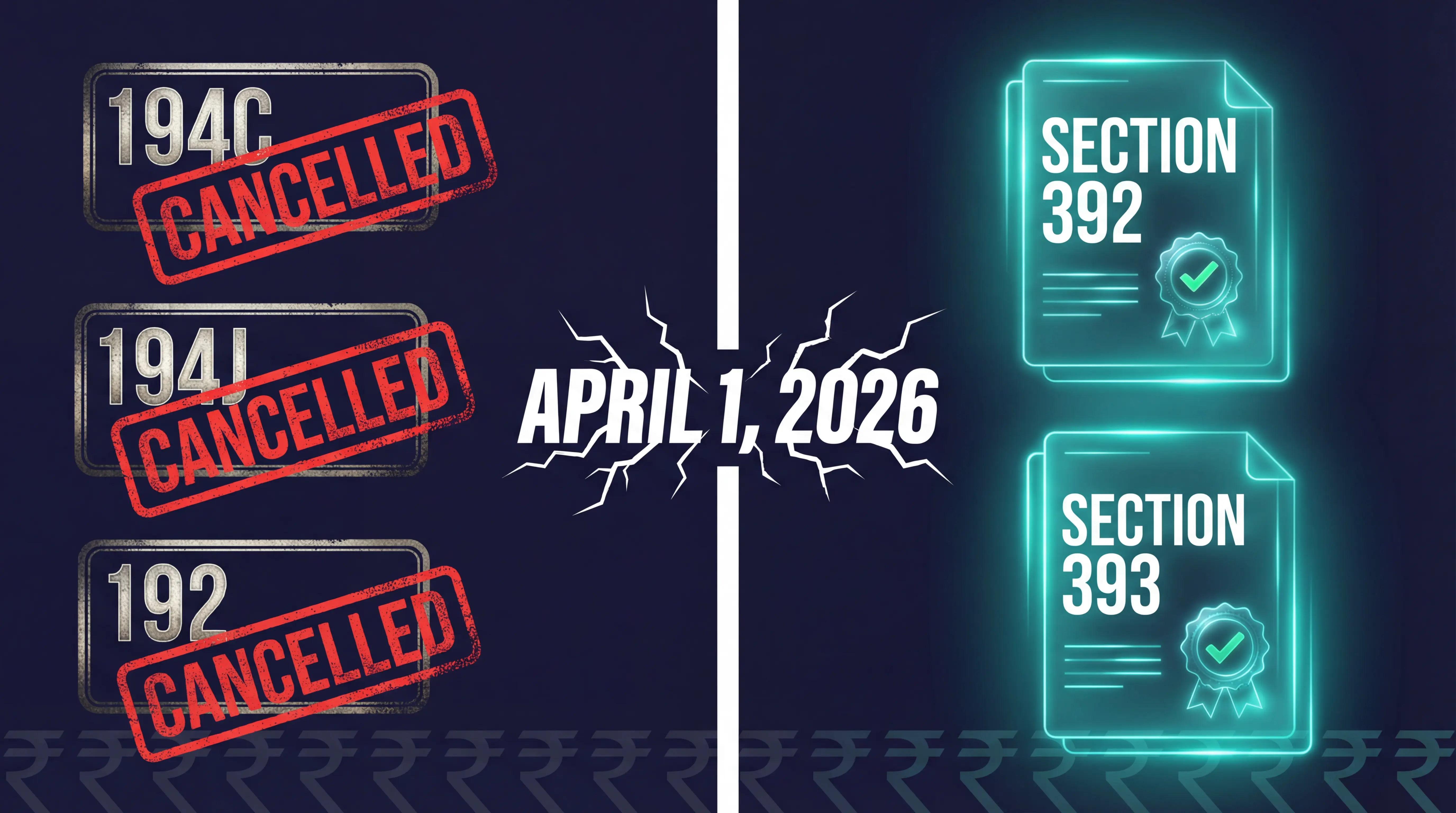
India's entire Tax Deducted at Source framework has shifted from the Income-tax Act, 1961 to the Income-tax Act, 2025. The sections you memorised 192, 194C, 194J, 194A are gone. New sections, new form numbers, new rules.
But here is what most people get wrong: they assume this is a complete overhaul. It is not. The rates and thresholds are largely the same. What changed is the governing law, the section numbers, the form numbers, and a set of critical transition rules that every deductor must get right in 2026 — or face interest and penalties.
I am going to cover every change, every transition scenario, every due date, and every new section with real examples so that whether you are a CA, a business owner, an HR manager, or a salaried taxpayer, you know exactly where you stand.
What Exactly Changed from April 1, 2026?
Let me start with the one line that matters most:
Any TDS obligation that arises on or after April 1, 2026 is governed by the Income-tax Act, 2025. Any obligation that arose on or before March 31, 2026 is still governed by the Income-tax Act, 1961.
That is the master rule. Everything else flows from this.
Under Rule 1 of the Income-tax Rules, 2026:
"These rules may be called the Income-tax Rules, 2026. They shall come into force on the 1st April, 2026."
Period | Governing Law |
|---|---|
Up to 31 March 2026 | Income-tax Act, 1961 |
From 1 April 2026 onwards | Income-tax Act, 2025 |
The new law presents TDS provisions in a simplified, tabular format. The old law had scattered sections with long provisos and explanations. The new law consolidates everything into two main sections Section 392 for salary and Section 393 for all other payments to residents.
The Core Trigger Rule Credit or Payment, Whichever is Earlier
Before I get into specific categories, you need to understand one rule that decides everything in the transition year.
For most non-salary TDS payments, the deduction obligation triggers at:
Credit: to the payee's account, OR
Actual payment: whichever happens first
So if you credit a contractor's payment on March 28, 2026 old law applies, even if you physically pay them on April 5, 2026.
For salary, the FAQ from Income Tax Department specifically clarifies that TDS is deducted at the time of payment not at the time of credit.
Payment Type | TDS Trigger |
|---|---|
Salary | Date of payment |
Contractor fees | Earlier of credit or payment |
Professional fees | Earlier of credit or payment |
Rent | Earlier of credit or payment |
Interest | Earlier of credit or payment |
Dividend | Earlier of credit or payment |
This distinction is critical. Get the trigger date wrong and you apply the wrong law — wrong section, wrong form, potentially wrong rate.
Section Mapping Old Sections vs New Sections
This is the section every CA and accountant needs to bookmark. Every TDS section you knew under the old Act has a new equivalent.
Salary TDS
Description | Old Act | New Act |
|---|---|---|
TDS on Salary | Section 192 | Section 392 |
All Other Payments Section 393 Replaces Multiple Old Sections
Under the new Act, Section 393(1) covers all TDS on payments to residents in a single consolidated table. Here is the complete mapping:
Payment Category | Old Section | New Section |
|---|---|---|
Insurance commission | 194D | Section 393(1) Sl. No. 1(i) |
Commission / brokerage (non-insurance) | 194H | Section 393(1) Sl. No. 1(ii) |
Rent non-specified person | 194I | Section 393(1) Sl. No. 2(i) |
Rent specified person | 194IB | Section 393(1) Sl. No. 2(ii) |
Transfer of immovable property | 194IA | Section 393(1) Sl. No. 3(i) |
JDA consideration | Section 393(1) Sl. No. 3(ii) | |
Compulsory acquisition compensation | 194LA | Section 393(1) Sl. No. 3(iii) |
Mutual fund / unit income | 194K | Section 393(1) Sl. No. 4(i) |
Business trust distribution | 194LBA | Section 393(1) Sl. No. 4(ii) |
Investment fund income | 194LBB | Section 393(1) Sl. No. 4(iii) |
Securitisation trust income | 194LBC | Section 393(1) Sl. No. 4(iv) |
Interest on securities | 193 | Section 393(1) Sl. No. 5(i) |
Bank / post office interest | 194A | Section 393(1) Sl. No. 5(ii) |
Other interest | 194A | Section 393(1) Sl. No. 5(iii) |
Contractor payments | 194C | Section 393(1) Sl. No. 6(i) |
Individual/HUF contractor/professional | 194M | Section 393(1) Sl. No. 6(ii) |
Professional / technical / royalty fees | 194J | Section 393(1) Sl. No. 6(iii) |
Dividend | 194 | Section 393(1) Sl. No. 7 |
Life insurance policy payout | 194DA | Section 393(1) Sl. No. 8(i) |
Purchase of goods above ₹50 lakh | 194Q | Section 393(1) Sl. No. 8(ii) |
Specified senior citizen income | 194P | Section 393(1) Sl. No. 8(iii) |
Benefit or perquisite from business | 194R | Section 393(1) Sl. No. 8(iv) |
E-commerce payments | 194O | Section 393(1) Sl. No. 8(v) |
Virtual Digital Assets | 194S | Section 393(1) Sl. No. 8(vi) |
Key takeaway: Sections 192, 193, 194, 194A, 194C, 194D, 194H, 194I, 194IA, 194IB, 194J, 194K, 194LA, 194M, 194O, 194P, 194Q, 194R, 194S all replaced. Do not use old section numbers in TDS returns, certificates, or compliance documents from April 2026.
Complete TDS Rate Chart for FY 2026-27
Based on Section 393(1) of the Income-tax Act, 2025, here is the full rate chart for payments to residents:
A. Payments to Residents Section 393(1)
Sl. No. | TDS Category | Payer | Rate | Threshold |
|---|---|---|---|---|
1(i) | Insurance commission | Any person | Rates in force | ₹20,000 |
1(ii) | Commission / brokerage (non-insurance) | Specified person | 2% | ₹20,000 |
2(i) | Rent (non-specified person) | Person other than specified | 2% | ₹50,000/month |
2(ii) | Rent plant/machinery | Specified person | 2% | ₹50,000/month |
2(ii) | Rent land/building/furniture | Specified person | 10% | ₹50,000/month |
3(i) | Transfer of immovable property (non-agricultural) | Person other than 3(iii) payer | 1% of higher of consideration or stamp duty | ₹50 lakh |
3(ii) | JDA consideration | Any person | 10% | Nil |
3(iii) | Compulsory acquisition compensation | Any person | 10% | ₹5,00,000 |
4(i) | Mutual fund / specified units income | Any person | 10% | ₹10,000 |
4(ii) | Business trust distribution to unitholder | Business trust | 10% | Nil |
4(iii) | Investment fund income (non-exempt) | Investment fund | 10% | Nil |
4(iv) | Securitisation trust income to investor | Securitisation trust | 10% | Nil |
5(i) | Interest on securities | Any person | Rates in force | ₹10,000 |
5(ii) | Bank/co-op/post office interest | Banking company / co-op bank / post office | Rates in force | ₹1,00,000 (senior citizen) / ₹50,000 (others) |
5(iii) | Other interest (non-banking) | Specified person other than 5(ii) | Rates in force | ₹10,000 |
6(i) | Contractor payments (specified cases) | Designated person | 1% (individual/HUF payee) / 2% (others) | ₹30,000 per payment and ₹1,00,000 aggregate |
6(ii) | Individual/HUF: contractor/professional/commission | Individuals/HUF covered here | 2% | ₹50,00,000 |
6(iii) | Professional / technical fees / director remuneration / royalty | Specified person | 2% (FTS, royalty for films, call centre) / 10% (others) | ₹50,000 for most; Nil for some |
7 | Dividend | Domestic company | 10% | Nil |
8(i) | Life insurance policy payout | Any person | 2% | ₹1,00,000 |
8(ii) | Purchase of goods above ₹50 lakh | Buyer | 0.1% | Amount exceeding ₹50,00,000 |
8(iii) | Specified senior citizen income | Specified bank | Rates in force | As applicable |
8(iv) | Benefit or perquisite from business/profession | Specified person | 10% | ₹20,000 |
8(v) | E-commerce sale/services payment | E-commerce operator | 0.1% of gross sales/services | Nil |
8(vi) | Transfer of Virtual Digital Asset | Any person | 1% | Nil |
Important note: Where the table shows "Rates in force" the exact operative rate must be verified from the Finance Act, 2026. These are not fixed statutory percentages but depend on the current Finance Act slab rates.
April 2026 Transition The 6 Scenarios You Must Know
This section is where most businesses will get confused. I am going to give you every scenario with a clear answer.
Scenario 1: Credit before April 1, Payment after April 1
Situation: Contractor invoice credited on March 28, 2026. Payment made on April 5, 2026. TDS already deducted in March.
Answer: Old law applies. TDS was correctly deducted in March under Section 194C of the Income-tax Act, 1961. No further deduction required in April. The April payment does not trigger fresh TDS because the obligation already arose at credit in March.
Scenario 2: Salary for March 2026
Situation: Salary for March 2026 paid on March 31, 2026.
Answer: Old law applies Income-tax Act, 1961, Section 192. Deposit due date: 30 April 2026.
Scenario 3: Salary for April 2026
Situation: Salary for April 2026 paid on April 30, 2026.
Answer: New law applies Income-tax Act, 2025, Section 392. Deposit due date: 7 May 2026.
Scenario 4: TDS deducted in January 2026, deposited late in May 2026
Situation: TDS deducted in January 2026 but deposited only in May 2026 late.
Answer: Interest calculation splits across both laws:
Interest from January 2026 to March 31, 2026 → governed by Income-tax Act, 1961
Interest from April 1, 2026 to date of deposit in May 2026 → governed by Income-tax Act, 2025, clause (g) of Section 536(2)
Practical impact: You cannot calculate total interest under just one law. You must split the interest calculation at March 31 / April 1 boundary.
Scenario 5: Contract payment credited in March, but contract ongoing into April
Situation: Service contract runs from March to April. March portion credited March 31. April portion credited April 30.
Answer:
March credit → old law, old section
April credit → new law, Section 393
Each credit is treated separately based on its date.
Scenario 6: Lower/Nil Deduction Certificate expiring March 31, 2026
Situation: Certificate valid from April 1, 2025 to March 31, 2026 expiring.
Answer: Fresh application required for the new period. Under Section 395 of the Income-tax Act, 2025, a new certificate covering April 1, 2026 to March 31, 2027 can be applied for if conditions continue to be met. The old certificate does not automatically extend.
TDS Deposit Due Dates Complete Table for 2026
The deposit due dates remain broadly the same. The key change is the governing law, not the calendar except for March 2026 which has a special date.
Non-Government Deductors
Period of TDS Deduction | Due Date for Deposit | Governed By |
|---|---|---|
January 2026 | 7 February 2026 | IT Act, 1961 |
February 2026 | 7 March 2026 | IT Act, 1961 |
March 2026 | 30 April 2026 ⚠️ | IT Act, 1961 |
April 2026 | 7 May 2026 | IT Act, 2025 / Rule 218 |
May 2026 onwards | 7th of next month | IT Act, 2025 / Rule 218 |
Government Deductors
Period | With Challan | Without Challan | Governed By |
|---|---|---|---|
January–February 2026 | 7th of next month | Same day | IT Act, 1961 |
March 2026 | 7 April 2026 | Same day | IT Act, 1961 |
April 2026 onwards | 7th of next month | Same day | IT Act, 2025 / Rule 218 |
Challan-Cum-Statement Cases (Form 26QB, 26QC, 26QD, 26QE)
For these special forms, the due date is:
30 days from the end of the month in which TDS was made
This timeline remains unchanged under the new Act
⚠️ March 2026 special note: March is the only month where non-government deductors get until April 30 not the 7th. This is because March falls at the old-law year-end. Do not confuse this with April's regular 7th deadline.
New TDS Return Forms What Changes from April 2026
Every TDS return form has a new number from Tax Year 2026-27. This is where your payroll software, accounting software, and TDS filing portal must be updated.
TDS Return Forms
Purpose | Old Form | New Form | Applicable From |
|---|---|---|---|
Salary TDS return | Form 24Q | Form 138 | Q1 TY 2026-27 (Apr–Jun 2026) |
Non-salary TDS return | Form 26Q | Form 140 | Q1 TY 2026-27 |
Non-resident TDS return | Form 27Q | Form 144 | Q1 TY 2026-27 |
TCS return | Form 27EQ | Form 143 | Q1 TY 2026-27 |
TDS Certificate Forms
Purpose | Old Form | New Form | Due Date |
|---|---|---|---|
Salary TDS certificate | Form 16 | Form 130 | 15 June 2027 (for TY 2026-27) |
Non-salary TDS certificate | Form 16A | Form 131 | 15 August 2026 (for Apr–Jun 2026) |
TCS certificate | Old format | Form 133 | As applicable |
Lower/nil withholding certificate | Form 13 | Form 128 | As applicable |
Book adjustment TDS/TCS statement | Old format | Form 137 | As applicable |
Transition Year Dual Filing Obligation
This is critical for CAs and TDS professionals. In FY 2026-27, you may need to file under both laws simultaneously:
Quarter | Period | Law | Form | Due Date |
|---|---|---|---|---|
Q4 FY 2025-26 | Jan–Mar 2026 | IT Act, 1961 | 24Q / 26Q / 27Q | 31 May 2026 |
Q1 TY 2026-27 | Apr–Jun 2026 | IT Act, 2025 | Form 138 / 140 / 144 | 31 July 2026 |
Q2 TY 2026-27 | Jul–Sep 2026 | IT Act, 2025 | New Forms | 31 October 2026 |
Old period corrections: Correction statements for Q1–Q4 of FY 2025-26 or earlier must still be filed under the Income-tax Act, 1961 framework even after the new Act comes into force.
How TDS Credit Will Split in 2026 Form 26AS vs Form 168
This affects every taxpayer when they file their return. TDS deducted across the transition year maps to two different reporting systems:
When TDS is Deducted | Maps To | Reflected In |
|---|---|---|
March 2026 or earlier | AY 2026-27 under old Act | Form 26AS |
April 2026 or later | Tax Year 2026-27 under new Act | Form No. 168 |
Form 26AS is the Annual Information Statement under the old system. Form 168 is its replacement under the Income-tax Rules, 2026.
Practical implication: If you have TDS deducted in both March and April 2026, you will see your TDS credit split across two different documents when you file your return for Tax Year 2026-27. Your CA or tax software must account for both. The e-filing portal will automatically segregate these credits but you need to verify the split is correct.
The No Double Deduction Rule Very Important
Here is a rule that protects businesses from being taxed twice on the same payment.
Official position: If tax has already been deducted before April 1, 2026 at the time of credit to the payee's account, no further deduction is required when the actual payment happens on or after April 1, 2026.
Example:
A law firm's invoice of ₹5,00,000 is credited to their account on March 25, 2026.
TDS of ₹50,000 (10%) is deducted under Section 194J of the old Act.
Actual payment is made on April 8, 2026.Result: No TDS required in April. The obligation was already fulfilled in March under the old Act. The April payment does not trigger fresh deduction under Section 393 of the new Act.
Compliance record to maintain:
Date of credit
Date of TDS deduction
Amount on which TDS was deducted
Old section used
Payment date in April or later
Reference that no fresh deduction applies
Keep this record clean if your vendor or a TDS officer questions the zero deduction in April, you need to show the March deduction clearly.
Salary TDS What Employers Must Do Differently
Salary is the most common TDS category for businesses with employees. Here is exactly what changes.
The Payment Date Rule for Salary
For salary, TDS is linked to the date of payment not the date of credit. This is different from other payments where credit triggers TDS.
Salary Month | Date of Payment | Applicable Law | Section |
|---|---|---|---|
March 2026 | 31 March 2026 | IT Act, 1961 | Section 192 |
March 2026 | 2 April 2026 | IT Act, 2025 | Section 392 |
April 2026 | 30 April 2026 | IT Act, 2025 | Section 392 |
Notice that March 2026 salary paid on April 2 falls under the new law because payment happened after April 1. This is the catch many employers miss. If you delay your March salary payment beyond March 31, the new Act applies.
Employer action items:
Update payroll software to use Section 392 from April 2026
Issue Form 130 (new Form 16) for TY 2026-27 not old Form 16
File Form 138 (new Form 24Q) for Q1 TY 2026-27 by July 31, 2026
For March 2026 salary paid in March file under old Form 24Q by May 31, 2026
Form 121 The TDS Exemption Declaration
If you receive income on which TDS applies but your total tax liability is nil — you stop TDS by submitting a declaration to your payer.
From April 1, 2026, this declaration is made in Form 121 which replaces the old Form 15G and Form 15H. A single form now covers all eligible taxpayers regardless of age.
Form 121 is prescribed under Rule 211 of the Income-tax Rules, 2026 and is backed by Section 393(6) which is part of the same Section 393 framework covering all non-salary TDS.
I have covered Form 121 in complete detail eligibility, eligible incomes, the income limit condition, UIN obligations, and how to fill it in the Form 121 complete guide on SmartGST. If you manage TDS for clients or your business, read that alongside this article.
Lower and Nil Deduction Certificates What Happens to Existing Certificates
Many businesses hold lower or nil TDS deduction certificates to reduce TDS burden on their income. Here is the transition position.
Certificates valid up to March 31, 2026: These expire with the old Act. Fresh applications must be made under Section 395 of the Income-tax Act, 2025 for the new period.
Fresh certificate applications from April 2026: Must be filed in Form 128 — which replaces old Form 13.
Example from official transition FAQ:
A nil deduction certificate valid from April 1, 2025 to March 31, 2026 can be followed by a fresh application for April 1, 2026 to March 31, 2027 if conditions continue to justify it.
Action required: If you currently hold a lower/nil TDS certificate, apply for renewal under the new Act immediately. Do not assume it auto-extends.
No New Circulars Under New Act Yet
As of March 2026, the Income Tax Department's official FAQ confirms that no circulars or notifications have been issued under the Income-tax Act, 2025 read with the Income-tax Rules, 2026 — because the new Act had not yet come into effect at the time of the FAQ.
This has two practical implications:
Old circulars under 1961 Act continue to provide guidance for transition period matters — including CBDT Circular No. 23/2017 on TDS treatment of GST on services (do not deduct TDS on separately shown GST component).
New circulars will follow as the new Act gets implemented. Watch the Income Tax Department portal at incometaxindia.gov.in for notifications under the new Act.
For the GST-TDS connection specifically the principle that TDS is deducted only on the service value, not on the GST component shown separately continues to apply under the new framework. I covered this in detail in the New Income Tax Rules 2026 guide.
Key Numbers Quick Reference
Item | Number / Date |
|---|---|
New Act effective date | 1 April 2026 |
Salary TDS new section | Section 392 |
Non-salary resident TDS new section | Section 393(1) |
TDS deposit March 2026 (non-govt) | 30 April 2026 |
TDS deposit March 2026 (govt with challan) | 7 April 2026 |
TDS deposit April 2026 onwards | 7th of next month |
Q4 FY 2025-26 TDS return deadline | 31 May 2026 |
Q1 TY 2026-27 TDS return deadline | 31 July 2026 |
New rules total rules | 333 |
New forms total forms | 190 |
Complete Compliance Checklist for FY 2026-27
Use this checklist to audit your TDS compliance from April 2026.
For Employers / Payroll Teams:
Payroll system updated to use Section 392 from April 2026
March 2026 salary TDS filed under old Form 24Q by 31 May 2026
April 2026 salary TDS to be filed under new Form 138 by 31 July 2026
Old Form 16 issued for FY 2025-26 by 15 June 2026
New Form 130 to be issued for TY 2026-27 by 15 June 2027
For Businesses Deducting TDS on Contractor/Professional Payments:
Section 194C replaced by Section 393(1) Sl. No. 6(i) update records
Section 194J replaced by Section 393(1) Sl. No. 6(iii) update records
Verify no double deduction for credits in March paid in April
Old Form 26Q for Q4 FY 2025-26 filed by 31 May 2026
New Form 140 for Q1 TY 2026-27 filed by 31 July 2026
For Banks and Financial Institutions:
TDS on FD interest from April 2026 under Section 393(1) Sl. No. 5(ii)
New bank interest threshold: ₹1,00,000 for senior citizens / ₹50,000 for others
Form 121 acceptance system updated old Form 15G/15H no longer valid
UIN generation for Form 121 declarations operational
Form 131 (new Form 16A) for non-salary TDS certificates from April 2026
For CAs and Tax Professionals:
All client TDS working papers updated with new section numbers
Dual filing tracked old forms for Q4 FY 2025-26, new forms from Q1 TY 2026-27
Correction statements for old periods filed under 1961 Act framework only
Lower/nil deduction certificates renewed under Section 395 in Form 128
Interest calculations split correctly at March 31 / April 1 boundary
TDS credit mapping explained to clients Form 26AS for old period, Form 168 for new
Key Dates Calendar Save This
Date | What Happens |
|---|---|
1 April 2026 | Income-tax Act, 2025 and Rules, 2026 come into force |
7 April 2026 | Government deductors: March 2026 TDS deposit due (with challan) |
30 April 2026 | Non-government deductors: March 2026 TDS deposit due |
31 May 2026 | Q4 FY 2025-26 TDS returns due (old forms 24Q/26Q/27Q) |
15 June 2026 | Old Form 16 for FY 2025-26 due |
31 July 2026 | Q1 TY 2026-27 TDS returns due (new forms 138/140/144) |
15 August 2026 | New Form 131 for April–June 2026 TDS certificates due |
31 October 2026 | Q2 TY 2026-27 TDS returns due |
15 June 2027 | New Form 130 (salary TDS certificate) for TY 2026-27 due |
Frequently Asked Questions
Q1. What are the new TDS rules from April 2026?
From April 1, 2026, TDS shifts to the Income-tax Act, 2025. The governing law for any TDS obligation depends on when the earlier of credit or payment happens. If that event happens by March 31, 2026 old Act applies. If it happens on or after April 1, 2026 new Act applies. Section numbers, form numbers, and return forms all change, but rates and thresholds are largely the same.
Q2. Which Act applies for TDS during the March-April 2026 transition?
Check the earlier of credit or payment. If that event is on or before March 31, 2026 Income-tax Act, 1961 applies. If it is on or after April 1, 2026 Income-tax Act, 2025 applies. For salary specifically, the payment date determines which law applies.
Q3. Do businesses need to amend existing contracts because of the new TDS rules?
No. Contract amendment is not required just because the governing TDS law changed. TDS will be determined based on the date of credit or payment, whichever is earlier, as per the relevant provision. Your invoicing and payment practices remain the same just the section you cite in returns changes.
Q4. What is the TDS deposit due date for March 2026?
For non-government deductors, TDS deducted in March 2026 must be deposited by 30 April 2026 not the usual 7th. For government deductors depositing with challan, the due date is 7 April 2026. Without challan same day as deduction.
Q5. Which TDS return form should I use for April and June 2026?
For Q1 of Tax Year 2026-27 (April to June 2026), use the new forms: Form 138 for salary, Form 140 for non-salary, Form 144 for non-resident payments, Form 143 for TCS. Due date is 31 July 2026.
Q6. What is the due date for Q4 FY 2025-26 TDS return?
31 May 2026. Use old forms 24Q for salary, 26Q for non-salary, 27Q for non-resident, 27EQ for TCS. This return is governed by the Income-tax Act, 1961.
Q7. What happened to Section 194C and Section 194J?
Both are replaced. Section 194C (contractor payments) is now Section 393(1) Sl. No. 6(i) under the Income-tax Act, 2025. Section 194J (professional/technical fees) is now Section 393(1) Sl. No. 6(iii). Rates are largely unchanged 1%/2% for contractors, 2%/10% for professional fees depending on category.
Q8. What happens to TDS credit if tax is deducted in both March and April 2026?
TDS deducted in March 2026 maps to AY 2026-27 and reflects in Form 26AS. TDS deducted from April 2026 maps to Tax Year 2026-27 and reflects in Form 168 the new Annual Information Statement under the Income-tax Rules, 2026. The e-filing portal segregates these automatically.
Q9. What is Form 121 and how does it relate to TDS?
Form 121 is the new declaration form under Section 393(6) that replaces Form 15G and Form 15H. Eligible taxpayers submit it to their bank or payer to stop TDS on interest, dividend, rent, and other specified incomes if their estimated total tax liability is nil. I have covered Form 121 in complete detail read the full Form 121 guide here.
Q10. How will interest on late TDS deposit be calculated if it spans March and April 2026?
Interest is calculated in two parts. For the period up to March 31, 2026 Income-tax Act, 1961 applies. For the period from April 1, 2026 to the date of deposit Income-tax Act, 2025, Section 536(2)(g) applies. You cannot use a single law for the entire interest calculation if the delay spans the transition date.
The Bottom Line
The new TDS framework under the Income-tax Act, 2025 is not a tax rate hike or a policy reversal. It is a structural modernisation the same rules, rewritten more clearly, in a tabular format, with updated section numbers.
But the transition year is genuinely complex. Two laws running side by side. Old section numbers for old-period corrections, new section numbers for new-period filings. Old forms for Q4 FY 2025-26, new forms from Q1 TY 2026-27. Interest calculations that split at a single date boundary.
The businesses and professionals who will get this right are the ones who treat April 2026 as a hard cutoff audit every transaction, update every system, and file under the correct law for the correct period.
The ones who will face notices are those who auto-continue old section numbers into April 2026 because their software did not update.
Check your payroll software. Check your TDS filing software. And if you use a CA ask them specifically whether their systems are updated for Section 392 and Form 138. Do not assume. Verify.
Manage Your GST Compliance Too
While you update your TDS processes for the new rules, your GST compliance calendar runs in parallel. Use our free SmartGST tools to stay on top of both:
Free GST Calculator Calculate CGST, SGST and IGST on any amount instantly
GSTIN Validator Verify any vendor's GST number before making payment — a fake GSTIN means lost ITC
HSN Code Finder Find the correct HSN code for your products instantly
No signup. No credit card. Free to use.