By SmartGST Editorial Team | Published: April 2026 | 15 min read
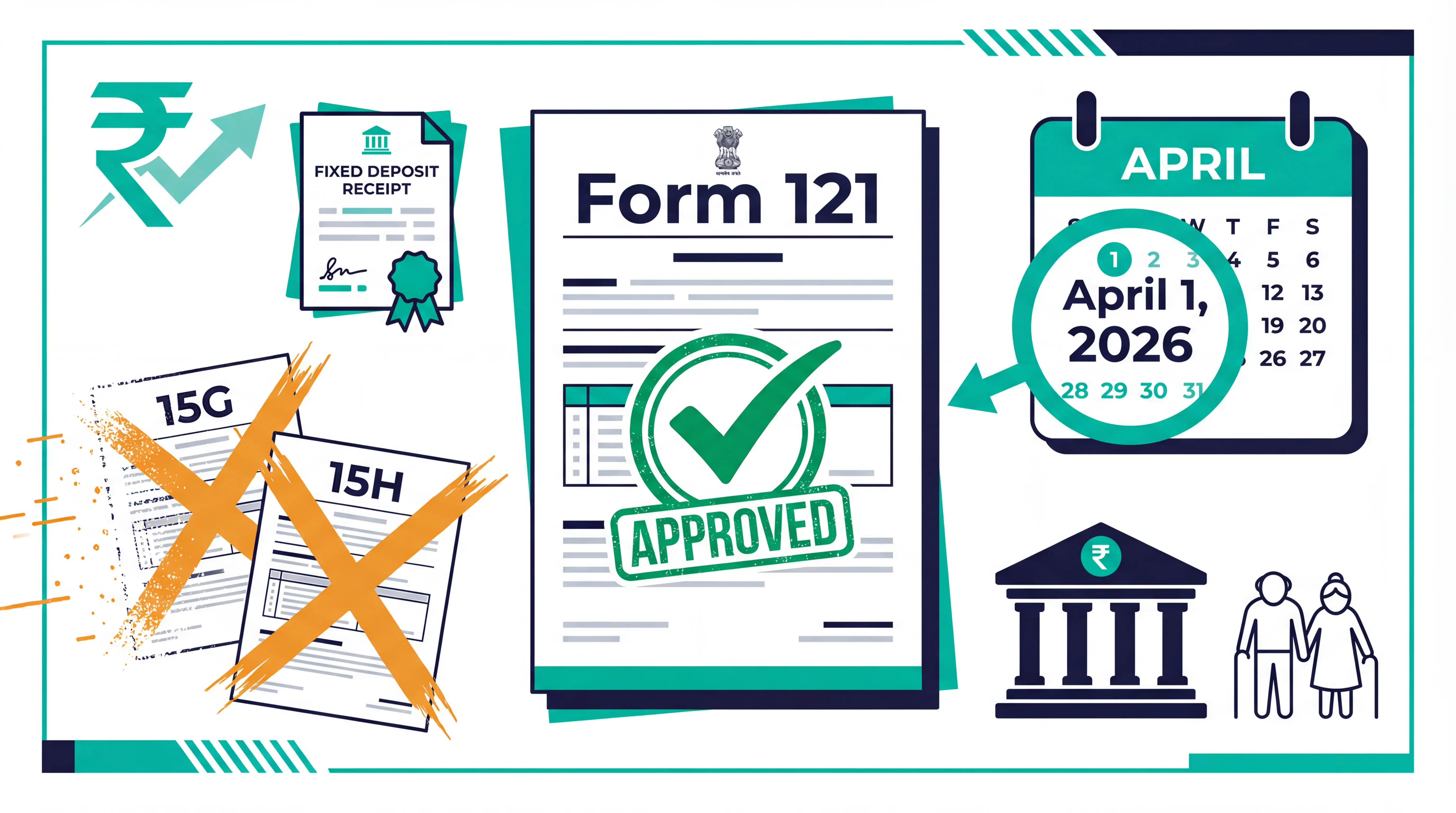
If you have ever walked into a bank and submitted Form 15G or Form 15H to stop TDS on your FD interest that form no longer exists from April 1, 2026.
The government has replaced both forms with a single new form called Form 121 under the Income-tax Act, 2025. And right now, most people do not even know this change happened.
I am going to explain exactly what Form 121 is, who can use it, which incomes it covers, what the income limit condition is, and what your bank needs to do after you submit it. By the end of this article, you will know everything you need to make sure TDS is not wrongly deducted from your income this year.
What is Form 121?
Form 121 is India's new official declaration form for receiving certain incomes without TDS deduction.
In simple language if your total estimated income for the year is below the taxable limit, you submit Form 121 to whoever is paying you (your bank, insurance company, employer, etc.) and tell them: "Do not deduct TDS from my payment because my total tax liability is nil."
The government prescribed Form 121 under Rule 211(1) of the Income-tax Rules, 2026. The legal authority comes from Section 393(6) of the Income-tax Act, 2025.
It officially replaces:
Form 15G — for individuals below 60 years and certain other persons
Form 15H — for senior citizens aged 60 and above
Both old forms are gone from Tax Year 2026-27 onwards. Form 121 is the single replacement for both.
Why Did the Government Replace 15G and 15H?
The honest answer is simplification.
The old system had two separate forms doing essentially the same job declaring nil tax liability to stop TDS. The new Income-tax Act, 2025 consolidated them into one. One form, one rule, one process.
This is part of the larger overhaul where the government reduced income tax forms from 399 to 190. I covered every major change from this overhaul in the New Income Tax Rules 2026 complete guide worth reading if you want the full picture.
Legal Framework Section 393(6) and Rule 211
I want to give you the exact legal reference because this matters when you are dealing with your bank or deductor and they claim they have never heard of Form 121.
Provision | Subject |
|---|---|
Section 393(6), Income-tax Act, 2025 | Declaration for no deduction at source where tax on estimated total income is nil |
Rule 211, Income-tax Rules, 2026 | Prescribes Form No. 121, manner of furnishing, UIN requirement, reporting obligations, and retention period |
The core condition from Section 393(6) is this: the tax on the person's estimated total income of the tax year in which such income is to be included shall be nil.
That one condition is the foundation of Form 121. If your estimated total tax is nil, you qualify. If it is not nil, you do not.
Who Can Submit Form 121 Eligibility
Not everyone can use Form 121. Here is exactly who qualifies:
✅ Eligible:
Resident individuals (any age)
Any person who is NOT a company and NOT a firm
❌ Not Eligible:
Companies
Firms (partnership firms, LLPs)
This means if you run a proprietorship, you can submit Form 121 as an individual. But if you run a private limited company or a partnership firm, you cannot use this form your deductor will deduct TDS regardless.
Senior Citizen Special Rule
The law gives a special relaxation to resident individuals aged 60 or more at any time during the tax year. I will explain this in detail in the income limit section below but if you are a senior citizen, your eligibility conditions are slightly easier than for younger taxpayers.
Which Incomes Can You Use Form 121 For?
This is the most important section, and I want to be precise because the eligible income list is different for different categories of people.
For Resident Individuals All 7 Income Types
If you are a resident individual, you can submit Form 121 for any of these incomes:
Clause | Income Type | Practical Example |
|---|---|---|
(a) | Accumulated PF balance payable to employee | EPF withdrawal when you change jobs |
(b) | Insurance commission | LIC agent commission income |
(c) | Rent from specified person | Rent paid by a company to an individual |
(d) | Income from units | Mutual fund unit income |
(e) | Interest income | Bank FD interest, savings interest, post office interest |
(f) | Life insurance policy payout | LIC maturity amount or surrender value |
(g) | Dividend | Dividend from shares or mutual funds |
Interest income (clause e) is the most commonly used one. This is where most people submit Form 121 to stop TDS on their bank FD interest.
For Other Eligible Persons (Not Company, Not Firm)
If you fall in this category say an HUF (Hindu Undivided Family) or an AOP (Association of Persons) you can use Form 121 for items (a) to (f) only.
Dividend (clause g) is NOT available for this category. Only resident individuals can use Form 121 for dividend income.
The Income Limit Condition Read This Carefully
Here is where most people get confused, and where banks sometimes make errors.
Form 121 does NOT work for everyone automatically. There is a restriction built into the Note under Section 393(6).
The restriction: If your aggregate eligible income during the year exceeds the maximum amount not chargeable to tax (the basic exemption limit), Form 121 benefit does not apply UNLESS you are a senior citizen.
Let me break this down with numbers:
Basic exemption limits for Tax Year 2026-27:
Below 60 years: ₹2,50,000 (under old regime) / ₹3,00,000 (under new regime)
60 to 80 years (senior citizen): ₹3,00,000
Above 80 years (super senior citizen): ₹5,00,000
Practical scenario:
Ramesh is 45 years old. His only income is FD interest of ₹3,20,000 per year.
His income exceeds the basic exemption of ₹2,50,000.
He CANNOT submit Form 121 his bank must deduct TDS.
Sunita is 62 years old. Her FD interest is ₹3,20,000 per year.
She gets the senior citizen special relaxation under the Note in Section 393(6).
She CAN submit Form 121 her bank should not deduct TDS.
This senior citizen relaxation is one of the most practical benefits in the new rules. Senior citizens with income slightly above the basic exemption limit but with nil actual tax liability (after deductions) get a real advantage here.
The golden rule: Before submitting Form 121, calculate your estimated total income for the year. If your tax liability comes to zero after all deductions, you qualify. If any tax is payable, do not submit Form 121 it will be a false declaration.
Form 121 Last Date When Exactly Should You Submit It?
Let me answer this clearly because I see a lot of confusion around this.
Form 121 does not have a single government-declared deadline like your ITR filing date or GST return due date. There is no "31st July submit karo" kind of fixed date for this form. But that does not mean you can submit it whenever you feel like it.
The right time to submit Form 121 is before your first payment of the year is credited to your account.
Once your bank credits the interest or your company pays the dividend TDS is already deducted. At that point, Form 121 is useless for that payment. You will have to wait until you file your ITR to claim that TDS back, and that refund can take months.
Income-Wise Deadline Submit Before This Happens
Different incomes have different payment timelines. Here is exactly when to submit Form 121 for each:
Income Type | |
|---|---|
Bank FD Interest | First week of April before the bank credits your first quarterly interest |
Savings Account Interest | April itself banks calculate interest half-yearly |
Post Office Deposit Interest | Before April 1 of the new tax year |
Dividend from Shares | Before the company's record date for dividend |
Mutual Fund Income | Before the dividend/income distribution date |
Insurance Commission | Before your first commission payment of the year |
Rent from Specified Person | Before the first rent payment of Tax Year 2026-27 |
PF/EPF Withdrawal | Before you initiate the withdrawal request |
The One Rule You Must Remember
I want you to remember just one thing from this entire section:
Submit Form 121 in April. Every year. Without fail.
April is the start of the tax year. No payments have been made yet. No TDS has been deducted. This is your window and it closes the moment your first payment hits your account.
If you miss April and your bank deducts TDS in May, June, or any other month that money is gone for now. You get it back only after filing your ITR, which means waiting until July or later, and then waiting more for the refund to process.
What Happens If You Submit Form 121 Late?
Here is the practical reality of missing the window:
Scenario 1 :— You submit in April (correct)
Your bank receives Form 121 before any interest is credited. No TDS is deducted for the entire year. You keep your full interest amount every quarter. Zero hassle.
Scenario 2 :— You submit in July (late)
Your bank already deducted TDS in April, May, and June three months of interest gone into TDS. From July onwards, no more TDS. But the first three months? You file ITR, claim refund, and wait 3 to 6 months for it to come back to your account.
Scenario 3 :— You do not submit at all
TDS gets deducted every quarter for the full year. You file ITR, claim the entire TDS as refund. The money comes back eventually but your cash flow takes a hit the entire year.
The numbers make this clear. Say your annual FD interest is ₹2,40,000. TDS at 10% = ₹24,000 per year. That is ₹6,000 per quarter sitting with the government instead of your account for no reason, if your tax liability is genuinely nil.
Payer's Deadline What Your Bank Must Do
Once you submit Form 121, the responsibility shifts to the payer — your bank, company, or whoever is paying you.
Under Section 393(7) of the Income-tax Act, 2025, the payer must:
Submit a copy of your Form 121 declaration to the jurisdictional Principal Chief Commissioner or Commissioner of Income Tax
Do this by the 7th of the month following the month in which they received your declaration from you
So if you hand over Form 121 to your bank on April 10, 2026 your bank must submit the copy to the tax authority by May 7, 2026. This is the bank's obligation, not yours. But it is good to know so you can follow up if needed.
One More Thing Submit to Every Payer Separately
This is where people make mistakes.
If you have a Fixed Deposit in SBI and another in HDFC Bank you need to submit Form 121 to both banks separately. One form does not cover all your income sources.
Similarly, if you earn dividend from two different companies, rent from a company, and interest from a post office scheme you need to submit Form 121 to each payer individually.
There is no central submission. Each payer needs their own declaration.
Quick Checklist Before You Submit Form 121
Before you walk into the bank or fill the online form, run through this quickly:
My estimated total income for Tax Year 2026-27 is below the taxable limit
My estimated tax liability for the year is nil
I am a resident individual or eligible non-company, non-firm entity
I have my PAN ready quoting PAN in Form 121 is mandatory
I am submitting this before the first payment is credited
I know I need to submit separately to each payer
If all boxes are checked go ahead and submit. If even one is unclear, calculate your estimated income for the year first before submitting. A false declaration in Form 121 can attract prosecution under the Income-tax Act.
📅 Never miss a tax deadline again. Use the SmartGST free Due Date Calendar to track all your TDS, GST, and ITR filing deadlines in one place no signup required.
How to Submit Form 121
Rule 211(2) gives two options:
Option 1: Electronic Submission (Recommended)
Submit Form 121 electronically through a verified electronic process. Most banks and financial institutions now accept this through their net banking or mobile app platforms. This is faster, leaves a digital trail, and is easier to track.
Option 2: Paper Form
Submit a physical signed paper form to the payer. Banks still accept this at the branch. If you are not comfortable with online processes, walk in with the filled form.
When to submit: Submit Form 121 at the beginning of the financial year ideally in April itself. Do not wait until the bank has already deducted TDS. Once TDS is deducted, you need to claim it back through your ITR filing, which is a longer process.
And while we are on the topic of deadlines use the SmartGST free Due Date Calendar to track all your tax compliance deadlines in one place. It covers GST filing dates, TDS due dates, and more. No signup needed.
How to Fill Form 121 Step by Step
Form 121 mein ye basic details fill karni hoti hain:
Name and PAN of the declarant
Assessment Year — for Tax Year 2026-27, write 2026-27
Income details — estimated total income and the specific
income for which declaration is madeDeclaration that estimated tax liability is nil
Signature — electronic or physical depending on mode
The official Form 121 PDF format is available on the Income Tax portal at incometaxindia.gov.in. For applications made on or after 1 April 2026, only the new Form 121 is valid old Form 15G/15H PDFs are no longer accepted.
What Your Bank or Payer Must Do After Receiving Form 121
This section is critical especially for CAs, accountants, and business owners who receive Form 121 from payees.
The payer's obligations under Rule 211(3), Rule 211(4), and Section 393(7) are clear and non-negotiable:
Obligation 1: Allot a UIN to Every Form 121
The payer must assign a Unique Identification Number (UIN) to each Form 121 received. This happens every quarter. The procedure and format for UIN allotment is set by the Director General of Income-tax (Systems).
Obligation 2: Report in TDS Return Even When TDS is Zero
Under Rule 211(4), the payer must include the Form 121 details along with the UIN in the TDS return statement under Rule 219.
Here is the part most people miss: this reporting is mandatory even when no TDS was deducted. Receiving a Form 121 and deducting zero TDS does not mean the payer has no reporting obligation. The statement must still be filed.
If you are a CA handling TDS compliance for a client, this is something to add to your quarterly checklist.
Obligation 3: Submit Copy to Tax Authority
Under Section 393(7), the payer must deliver one copy of the Form 121 declaration to the jurisdictional Principal Chief Commissioner or Commissioner of Income Tax by the 7th of the month following the month in which the declaration was received.
Trigger | Deadline |
|---|---|
Form 121 received in April 2026 | Copy to tax authority by 7 May 2026 |
Form 121 received in July 2026 | Copy to tax authority by 7 August 2026 |
Obligation 4: Retain Records for 7 Years
Under Rule 211(5), the payer must keep every Form 121 received safely for 7 years from the end of the tax year in which it was received. An income tax authority can ask for these records at any time within that 7-year window for verification or any proceeding under the Act.
Practical advice: Banks typically handle this automatically. But if you are a business receiving Form 121 from individuals you pay rent or commission to, set up a proper document management system. Seven years is a long time, and a missing Form 121 during a scrutiny can create problems.
Speaking of compliance if you ever get a GST notice or face a penalty situation, check the GST Late Fee & Penalty Complete Guide 2026 on SmartGST. It covers exact penalty calculations for GSTR-1, GSTR-3B, and GSTR-9 with real examples.
Form 121 vs Form 15G vs Form 15H Full Comparison
Here is everything side by side so you can see exactly what changed:
Parameter | Form 15G (Old) | Form 15H (Old) | Form 121 (New) |
|---|---|---|---|
Applicable law | Income-tax Rules, 1962 | Income-tax Rules, 1962 | Income-tax Rules, 2026 |
Who uses it | Individuals below 60, HUF, etc. | Resident individuals 60+ | Resident individuals + non-company/firm |
Number of forms | Separate form | Separate form | Single unified form |
Legal section | Section 197A, IT Act 1961 | Section 197A, IT Act 1961 | Section 393(6), IT Act 2025 |
Covers dividend | Yes | Yes | Yes (resident individuals only) |
UIN requirement | Yes | Yes | Yes (Rule 211) |
Electronic filing | Yes | Yes | Yes |
Paper filing | Yes | Yes | Yes |
Record retention | 7 years | 7 years | 7 years |
Effective from | Now defunct | Now defunct | 1 April 2026 |
The bottom line: Form 121 does everything Form 15G and 15H did just in one form, under a new law.
Common Mistakes to Avoid
I see these errors repeatedly, and they can result in either excess TDS deduction or worse a false declaration:
Mistake 1: Submitting Form 121 when your income exceeds the basic exemption
If your FD interest alone is ₹4 lakh and you are 45 years old, you cannot submit Form 121. Your income exceeds the basic exemption limit. Many people still submit it that is a false declaration under tax law.
Mistake 2: Not submitting Form 121 on time
Submitting Form 121 in August for income received since April means your bank has already deducted TDS for April, May, June, and July. You get those months' TDS back only through ITR unnecessary hassle.
Mistake 3: Thinking Form 15G still works
From Tax Year 2026-27, Form 15G and 15H are invalid. If your bank is still accepting them, they are making an error. You need to submit Form 121. Period.
Mistake 4: Assuming companies and firms can submit Form 121
They cannot. If you advise a company to submit Form 121 to stop TDS on interest, that is incorrect. Companies must bear TDS and adjust it against their tax liability.
Mistake 5: Payer not filing TDS return with Form 121 details
Even if TDS is zero, payers must report Form 121 receipts with UIN in their quarterly TDS returns. Skipping this is a compliance failure.
Form 121 and GST A Practical Note for Business Owners
If you are a business owner who pays professional fees, commission, or rent to individuals you sit on both sides of this equation.
As a deductor, when someone gives you Form 121, you stop TDS but still need to report it. That keeps your TDS compliance clean.
As a service provider, remember that TDS is deducted only on the service value not on the GST portion of your invoice. I explained this in detail with a full example in the New Income Tax Rules 2026 article the GST-TDS connection section specifically.
And before you pay any vendor always verify their GSTIN is active and genuine. A payment to a vendor with a fake or cancelled GSTIN means you lose your ITC claim entirely. Here is how to check any GST number in 30 seconds a mistake that costs businesses crores every year.
Use the SmartGST free GSTIN Validator to instantly verify any GSTIN before making a payment.
Key Dates Form 121 Compliance Calendar
Action | Timeline |
|---|---|
Submit Form 121 to payer | Start of tax year — April 2026 |
Payer allots UIN | Every quarter |
Payer submits copy to tax authority | 7th of the following month |
Payer includes in TDS return | Quarterly, as per Rule 219 |
Record retention by payer | 7 years from end of tax year |
Frequently Asked Questions
Q1. Is Form 121 the same as Form 15G?
Form 121 replaces Form 15G it is not the same form. Form 15G was used under the Income-tax Rules, 1962. Form 121 is prescribed under Rule 211 of the Income-tax Rules, 2026, effective from 1 April 2026. The purpose is identical declaring nil tax liability to stop TDS, but the legal framework, form number, and structure are new.
Q2. Can a senior citizen use Form 121?
Yes, absolutely. In fact, senior citizens (aged 60 or above) get a special relaxation under the Note in Section 393(6). Even if their aggregate eligible income slightly exceeds the basic exemption limit, they may still qualify to submit Form 121 subject to their actual estimated tax liability being nil. This is an advantage senior citizens had with Form 15H, and it continues with Form 121.
Q3. Can I use Form 121 for FD interest income?
Yes. Bank FD interest falls under clause (e) interest income under Section 393(1) which is explicitly covered by Form 121. This is the most common use case. Submit Form 121 to your bank at the start of the financial year if your estimated total income is below the taxable limit.
Q4. What happens if I do not submit Form 121 on time?
Your bank or payer will deduct TDS at the applicable rate typically 10% on interest income. You will then need to claim this TDS back when you file your Income Tax Return (ITR). You get the money back eventually, but it blocks your cash flow for months. Always submit Form 121 early in April.
Q5. Can a company or firm submit Form 121?
No. Section 393(6) explicitly restricts Form 121 to resident individuals and persons who are neither a company nor a firm. If you operate as a private limited company, LLP, or partnership firm, you cannot submit Form 121. TDS will be deducted on your income, and you adjust it against your company's tax liability.
Q6. Is Form 121 available online?
Yes. Rule 211(2) allows Form 121 to be submitted electronically through a verified electronic process. Most banks and financial institutions will accept it through their digital platforms. The Income Tax portal at incometaxindia.gov.in is also expected to support Form 121 submission for Tax Year 2026-27. You can also submit it in paper form at the branch if you prefer.
Q7. What is the income limit to use Form 121?
You can use Form 121 only if your estimated total income for the year is within the basic exemption limit meaning your total tax liability is nil. For Tax Year 2026-27, the basic exemption under the old regime is ₹2,50,000 for those below 60, ₹3,00,000 for those aged 60 to 80, and ₹5,00,000 for those above 80. If your income exceeds these limits and you still have tax payable, submitting Form 121 would be a false declaration.
Q8. What is UIN in Form 121?
UIN stands for Unique Identification Number. Under Rule 211(3), every payer who receives a Form 121 must assign a unique UIN to that declaration every quarter. This UIN is then reported in the payer's quarterly TDS return. The purpose of UIN is traceability the tax department can match each Form 121 declaration with the corresponding TDS return filing to verify that no TDS was correctly not deducted.
The Bottom Line
Form 121 is not a complicated change it is a straightforward replacement of two old forms with one new form. But because most people, and many banks, do not know about it yet, there is a real risk of unnecessary TDS deduction in April and May 2026.
If your total income is below the taxable limit submit Form 121 to your bank right now. Do not wait. Every month you delay is TDS deducted that you then have to chase back through ITR.
If you are a CA or a tax professional update your client checklist today. Form 15G and 15H are gone. Form 121 is the new standard. Your clients who relied on 15G and 15H need to know this before their next FD renewal or dividend payment.
The rule changed. The process stays the same. Submit early, stay compliant.
Track all your tax and GST compliance deadlines with SmartGST's free Due Date Calendar covers TDS, GST returns, and annual filing dates. No signup, no credit card.