Your Vendor's GST Number Could Be Fake — Here's How to Check It in 30 Seconds
Last year, a shop owner in Pune paid ₹8 lakh to a supplier. GST invoice? Check. GSTIN on the invoice? Present. Everything looked completely fine.
Six months later, a notice arrived from the GST department. The supplier's GSTIN had been cancelled three months before the transaction. The ₹1.44 lakh GST the shop owner had claimed as Input Tax Credit? Rejected. Interest on top of that? Another ₹22,000.
Total damage: over ₹1.6 lakh. For a mistake that a 30-second online check would have prevented.
This is not a rare story. This is happening every day across India to small traders, large businesses, and everyone in between. And the scary part? Most people don't even know they should be checking.
This guide is going to change that. By the time you finish reading, you'll know exactly what a GSTIN is, how to read every single digit of a GST number like a pro, why validating it before a transaction is non-negotiable, and how to do it for free in seconds, even if you're completely new to GST.
What is GSTIN? (Simple Explanation)
Let's start from scratch, because this matters.
GSTIN stands for Goods and Services Tax Identification Number.
Think of it like an Aadhaar card, but for businesses. Just like every Indian citizen has a unique Aadhaar number linked to their identity, every GST-registered business in India has a unique GSTIN linked to their tax identity.
When GST was launched in India on 1st July 2017, it replaced a confusing mix of old tax numbers VAT (Value Added Tax) TIN (Tax Payer Identification Number), Service Tax registration, Central Sales Tax number, and many more. All of them got replaced by one single number: the GSTIN.
Every time a GST-registered business issues an invoice, that invoice must carry their GSTIN. Every time you file a GST return, it goes under your GSTIN. Every ITC claim you make whether it gets approved or rejected depends entirely on this number.
It is literally the backbone of the entire GST system.
Who Gets a GSTIN?
Not every business needs one, but most do. Here's who must register under GST:
Any business selling goods with annual turnover above ₹40 lakh (in most states)
Any business providing services with turnover above ₹20 lakh
Sellers on e-commerce platforms like Amazon, Flipkart, Meesho regardless of turnover
Businesses making interstate sales regardless of turnover
Anyone required to deduct TDS under GST
Importers, exporters, and non-resident taxable persons
Important: One PAN can have multiple GSTINs. If your business operates in Delhi, Maharashtra, and Karnataka you'll have a separate GSTIN for each state. Same PAN, three different GSTINs. This is completely normal and legal.
GSTIN Format 15 Digits Decoded
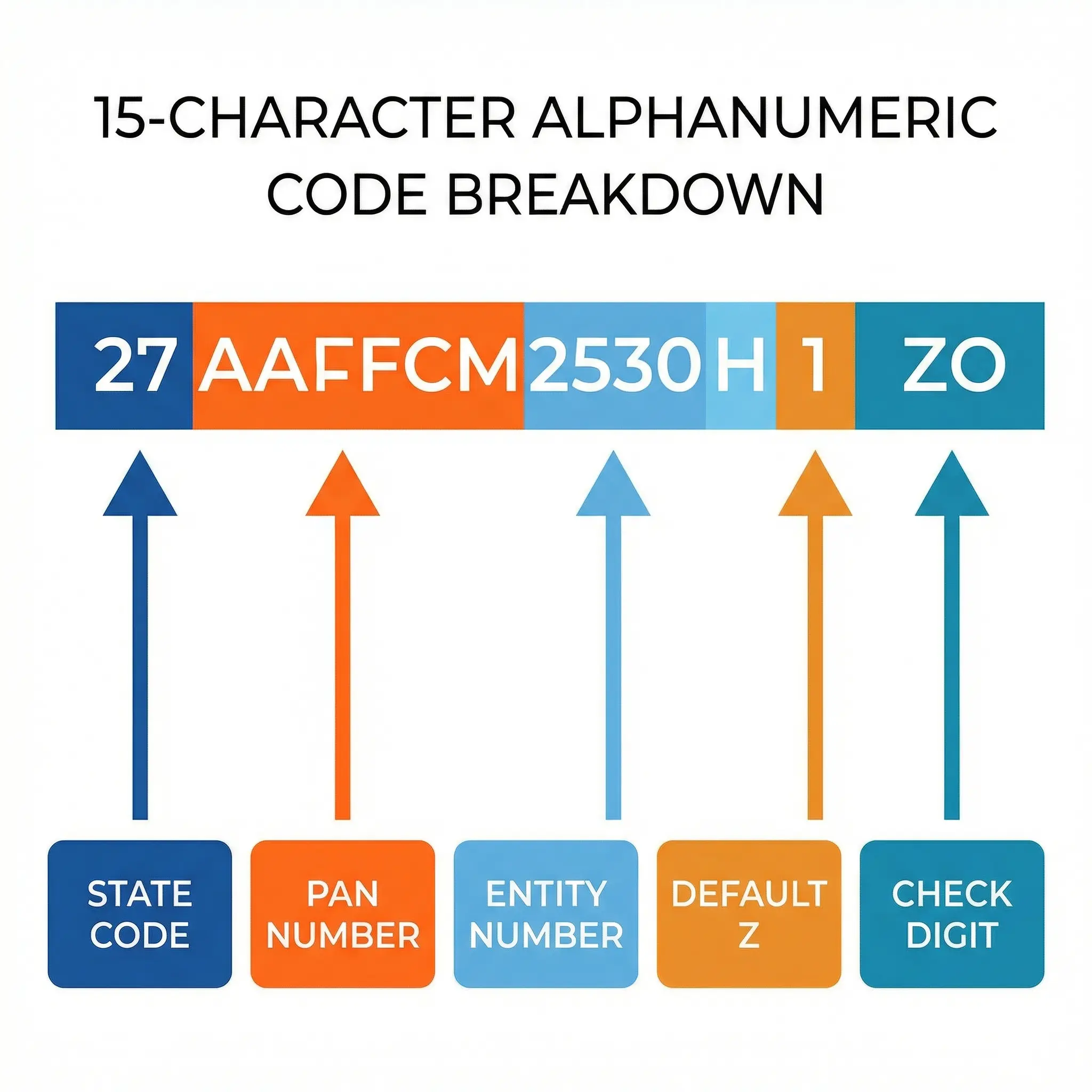
Now comes the part most people skip and they really shouldn't. Once you understand the structure of a GSTIN, you can catch a fake number without even using any tool.
A GSTIN is always exactly 15 characters long. Not 14, not 16. Always 15.
Let's take a real example and decode it character by character: 27AAFCM2530H1ZO
Position | Characters | What It Represents | In Our Example |
|---|---|---|---|
1 – 2 | 2 digits | State Code (as per Indian Census) |
|
3 – 12 | 10 characters | PAN of the taxpayer |
|
13 | 1 digit | Entity number (nth GSTIN for this PAN in this state) |
|
14 | 1 letter | Default character —> always 'Z' |
|
15 | 1 character | Check digit (auto-calculated by system) |
|
Breaking It Down Simply
Digits 1–2 (State Code) Every Indian state has a unique 2-digit code under GST. Maharashtra is 27, Delhi is 07, Uttar Pradesh is 09, Karnataka is 29, Tamil Nadu is 33. If a Delhi-based supplier gives you a GSTIN starting with 29, something is off either they have a Karnataka registration too, or the number is wrong.
Digits 3–12 (PAN) This is the taxpayer's 10-digit PAN number embedded right inside the GSTIN. This is important. It means you can cross-check: if a supplier says their PAN is AAFCM2530H but their GSTIN has AAFCM9999H in positions 3–12, there's a clear mismatch. These two must match exactly.
Digit 13 (Entity Number) Tells you how many times this PAN has registered for GST in the same state. 1 means first registration. 2 or 3 means the same PAN has multiple GST registrations in that state which can happen but should be verified.
Digit 14 (Always Z) Always the letter Z. No exceptions. If it's anything else, the GSTIN is structurally invalid.
Digit 15 (Check Digit) Calculated by the system using a specific algorithm applied to the first 14 characters. Validation tools use this to instantly catch numbers that have been tampered with or randomly made up.
Quick fake-detection trick (no tool needed): Is the number exactly 15 characters? Is digit 14 the letter 'Z'? Is the state code (first 2 digits) a real Indian state code? Does digits 3–12 look like a valid PAN format (2 letters + 4 digits + 1 letter + 1 digit + 1 letter)? If any of these fail it's already suspicious, before you even hit the database.
Why Validate Supplier GSTIN Before ITC Claim
Here's where the real money is involved. Please read this section carefully.
ITC (Input Tax Credit) is one of the biggest benefits of GST. When you buy goods or services for your business and pay GST on them, you can deduct that GST from what you owe the government.
Simple example: You paid ₹18,000 GST to your supplier. You owe ₹25,000 GST to the government. With ITC, you only pay ₹7,000. The ₹18,000 becomes your credit.
But here's what the GST law is very clear about: you can only claim ITC if your supplier is genuinely GST-registered AND has actually deposited that tax to the government.
If your supplier's GSTIN is invalid, you lose the credit. Period.
What Happens With Each GSTIN Status
GSTIN Status | What It Means | Can You Claim ITC? |
|---|---|---|
✅ Active | Valid, registered, returns being filed | Yes |
⚠️ Suspended | Temporarily blocked (investigation) | Very Risky —> consult CA |
❌ Cancelled | Registration terminated | No |
❌ Not Found | Fake or non-existent number | No |
When Should You Validate?
Before onboarding any new supplier —> make this a standard step, non-negotiable
Before any high-value purchase —> the higher the invoice, the more important the check
Every quarter —> run a bulk check on your top vendors
Any time something looks off —> address on invoice changed, entity name different, anything
The 2023 Budget tightened ITC rules significantly. Your ITC is now directly tied to what appears in your auto-generated GSTR-2B. If a supplier doesn't file their GSTR-1, your credit simply does not appear and you cannot claim it, even if you genuinely paid the GST.
The tax department will not refund your money if you get cheated by a vendor with a fake GSTIN. Your First responsibility to verify is entirely on you the buyer.
How to Validate GSTIN Online Step by Step
Good news: you don't need to be a CA or a tax expert to do this. It takes under a minute.
→ Use the Free GSTIN Validator on SmartGST
Step 1 Enter the GSTIN
Type or paste the 15-character GSTIN into the validator.
Step 2 Format Check (Instant)
The tool immediately checks the structure: state code valid, PAN format correct, digit 14 is Z, check digit matches. This happens in milliseconds, without even hitting the database.
Step 3 Live Database Query
If format passes, the tool queries the GSTN government database in real time the same database the GST department uses.
Step 4 Read the Results
You get back:
Legal name of the taxpayer
Trade name (if different from legal name)
Type of business (proprietorship, partnership, company, etc.)
State of registration
Date of registration
Current status: Active / Cancelled / Suspended
Alternative: Official Government Portal
Go to gst.gov.in
Click Search Taxpayer → Search by GSTIN/UIN
Enter the GSTIN and complete the CAPTCHA
Check the status and taxpayer details
The government portal is free and accurate, but requires a CAPTCHA every single time — which makes it impractical when you have multiple numbers to check. For anything beyond 2–3 GSTINs, use the SmartGST validator.
Bulk GSTIN Validation For Businesses With Many Suppliers
If you're managing vendor payables, doing monthly reconciliation, or just finished a busy quarter with 50+ purchase invoices checking GSTINs one by one is simply not a realistic workflow.
→ Bulk GSTIN Validator — Check 100+ Numbers at Once
How It Works
Prepare a CSV file with your GSTINs (one per row)
Upload the file to the bulk validator
Get a complete validation report for all GSTINs in one go
Download the report shows Active, Cancelled, Invalid, and Suspended separately
When to Run a Bulk Check
The best time is before you file your GSTR-3B each month. Catch problem vendors before your return is submitted not after a notice arrives.
For larger businesses, bulk GSTIN validation should be a fixed item on your monthly closing checklist. It takes 5 minutes and can protect you from ITC disallowances worth lakhs.
Common GSTIN Errors and What They Mean
When validating a GSTIN, you'll get somthings error message. Here's what each one means in plain language and exactly what to do next.
Invalid GSTIN Format
What it means: The number doesn't follow the correct 15-character pattern.
What to do: Almost always a typo. Common mix-ups are the letter O vs the number 0, and the letter I vs the number 1. Ask your supplier to share a photo of their GST registration certificate and re-enter carefully.
GSTIN Not Found in Database
What it means: The format is correct, but this number doesn't exist in GSTN's records.
What to do: Ask your supplier for their GST registration certificate. Cross-check the GSTIN printed on the certificate with what's on the invoice. If they can't produce a certificate, or the numbers still don't match do not transact.
Registration Cancelled
What it means: This GSTIN existed at some point but has been cancelled either voluntarily (business closed or deregistered) or by the tax authority (non-compliance, fraud).
What to do: Find out when exactly it was cancelled. If the cancellation date is before your invoice date, that invoice carries no GST validity. No ITC can be claimed. You'll need either a fresh invoice from a valid entity or a non-GST invoice.
Registration Suspended
What it means: The registration is temporarily blocked by the tax department usually during an investigation or for serious return filing defaults.
What to do: Don't claim ITC on purchases made during the suspension period without consulting your CA. The suspension may be resolved, but the risk during that window is real.
PAN Mismatch
What it means: The PAN embedded in the GSTIN (digits 3–12) doesn't match the PAN the supplier provided separately.
What to do: Get it clarified in writing before paying. It might be a genuine data entry error (wrong GSTIN mentioned on invoice) or it could be something more serious. Either way verify first, pay later.
How to Search GST Number by PAN
Sometimes you know a supplier's PAN but not their GSTIN. Maybe they forgot to mention it, or you want to verify all their state-wise registrations independently.
On the GST portal:
Go to gst.gov.in
Click Search Taxpayer → Search by PAN
Enter the 10-digit PAN
The portal shows all GSTINs linked to that PAN, across all states
This is also a useful fraud check. If a vendor claims to be a Delhi-based business, their GSTIN should start with 07. If the PAN lookup shows no Delhi registration that's a red flag worth questioning.
How to Spot a Fake GSTIN (Without Any Tool)
You can catch a lot of fake GSTINs just by looking at them carefully:
Count the characters —> if it's not exactly 15, it's invalid
Check digit 14 —> if it's not the letter
Z, it's structurally wrongCheck the state code —> look up the first 2 digits against a state code list
Validate the PAN portion —> digits 3–12 must follow PAN format: 5 letters + 4 numbers + 1 letter (e.g.,
ABCDE1234F)Cross-match with PAN —> ask for the supplier's PAN card and compare digits 3–12
None of these replace a live database check, but they'll catch obvious fakes instantly.
GSTIN vs GSTN What Is the Difference?
This confuses a lot of people, so let's settle it clearly.
Term | Full Form | What It Is |
|---|---|---|
GSTIN | Goods and Services Tax Identification Number | Your unique 15-digit GST number printed on invoices |
GSTN | Goods and Services Tax Network | The government technology company that runs the GST portal and database |
Your GSTIN is stored in the GSTN database. Think of GSTN as the bank, and GSTIN as your account number in that bank.
FAQs
How do I decode a GSTIN number?
Break it into 5 parts: digits 1–2 are the state code, digits 3–12 are the taxpayer's PAN, digit 13 is the entity count, digit 14 is always Z, and digit 15 is the check digit. The full worked example with a table is in the "15 Digits Decoded" section above.
Can I verify a GST number online for free?
Yes. Use SmartGST's free GSTIN Validator or the official government portal at gst.gov.in. Both query the live GSTN database at no cost.
What does the last digit of a GST number mean?
It's the check digit automatically calculated by the system using a mathematical algorithm applied to the first 14 characters. Validators use this to instantly detect fake or tampered numbers.
How do I confirm if a company is genuinely GST-registered?
Validate their GSTIN, check that the legal name matches the invoice, confirm status is "Active," and cross-check the embedded PAN (digits 3–12) against their PAN card. If all four match you're good.
What is a 15-digit GST number?
Every GSTIN in India is exactly 15 characters made up of a 2-digit state code, 10-character PAN, and 3 more characters for entity count, default letter (Z), and check digit.
How to check if a GST number is Active or Cancelled?
Enter it in the GSTIN Validator. The live database query returns the current status: Active, Cancelled, or Suspended along with the taxpayer's name and registration date.
Can one PAN have multiple GSTINs?
Yes. A business operating in multiple states will have a separate GSTIN for each state — all linked to the same PAN. This is completely normal. Each state registration is independent.
How do I calculate ITC from validated purchases?
Once you've confirmed a supplier's GSTIN is Active, use the ITC Calculator on SmartGST to calculate exactly how much Input Tax Credit you can claim based on purchase value and applicable GST rate.
How to check GST active status?
Visit SmartGST's validator, enter the GSTIN, and the tool will show you the current active status directly from the GSTN database.
How to check if GST registration is valid or not?
A GST registration is valid if: (1) the GSTIN exists in the database, and (2) the status shows "Active." If either condition fails the registration is not valid for ITC purposes.
Final Word: 30 Seconds That Could Save You Lakhs
GST compliance is not just about filing returns on time. It's about making sure every piece of the supply chain especially your supplier's side is in order before money changes hands.
You can't control what your vendor does with the tax they collect from you. You can't force them to file their GSTR-1. But you can make sure, before you sign the purchase order or transfer the payment, that their GST registration is real and currently active.
That one check which takes less time than reading this sentence is the difference between smooth ITC claims every quarter and a surprise notice from the GST department.
Validate before you pay. Always.
→ Validate 100+ GSTINs at Once Bulk Tool
→ Calculate Your ITC Eligibility
→New Income Tax Rules 2026 TDS on GST invoices explained simply
→Form 121 in Income Tax: Complete Guide for 2026
Information in this article is based on GST laws applicable in India as of the date of publication. GST rules are subject to change. For business-specific tax advice, consult a qualified Chartered Accountant or GST practitioner.