The Biggest GST Overhaul Since 2017 Is Already Live Is Your Business Ready?
On 22 September 2025, India's GST system changed more in a single day than it had in the previous five years combined.
The 12% slab is effectively gone. The 28% slab has been slashed for most goods. A new 40% bracket now covers luxury and sin goods. And 375 items got cheaper overnight from your AC to your health insurance to the medicines you buy at the chemist.
If you run a business and you have not audited your GST rate classification since September 2025, there is a real chance you are either overcharging customers or undercharging tax both of which create problems when a GST notice lands.
This guide gives you the complete picture: what changed, what it means for each sector, what your business needs to do right now, and the exact tools to check whether your products and services are correctly classified under the new structure.
Why GST 2.0 Happened The Problem With the Old System
Ask any accountant who has been filing GST returns since 2017 and they will tell you the same thing: the old rate structure was a classification nightmare.
The four-slab system 5%, 12%, 18%, and 28% sounds straightforward on paper. In practice, it created thousands of classification disputes. Is a chocolate-coated biscuit taxed at 18% (as a confectionery) or at 28% (as a luxury snack)? Does an ayurvedic hair oil go under the 12% medicinal slab or the 18% cosmetics slab? Is a ready-to-eat paratha the same as a chapati (0%) or a processed food product (12%)?
These disputes were not hypothetical. Between 2017 and 2025, classification-related show cause notices formed a significant chunk of all GST litigation. Businesses spent money on lawyers and CAs to defend rate choices that should have been obvious. Small businesses without that legal infrastructure just paid up.
The GST Council specifically the Group of Ministers (GoM) on rate rationalisation spent two years studying the problem. The 55th Council meeting in December 2024 set the stage. The 56th Council meeting on 3 September 2025 delivered the verdict.
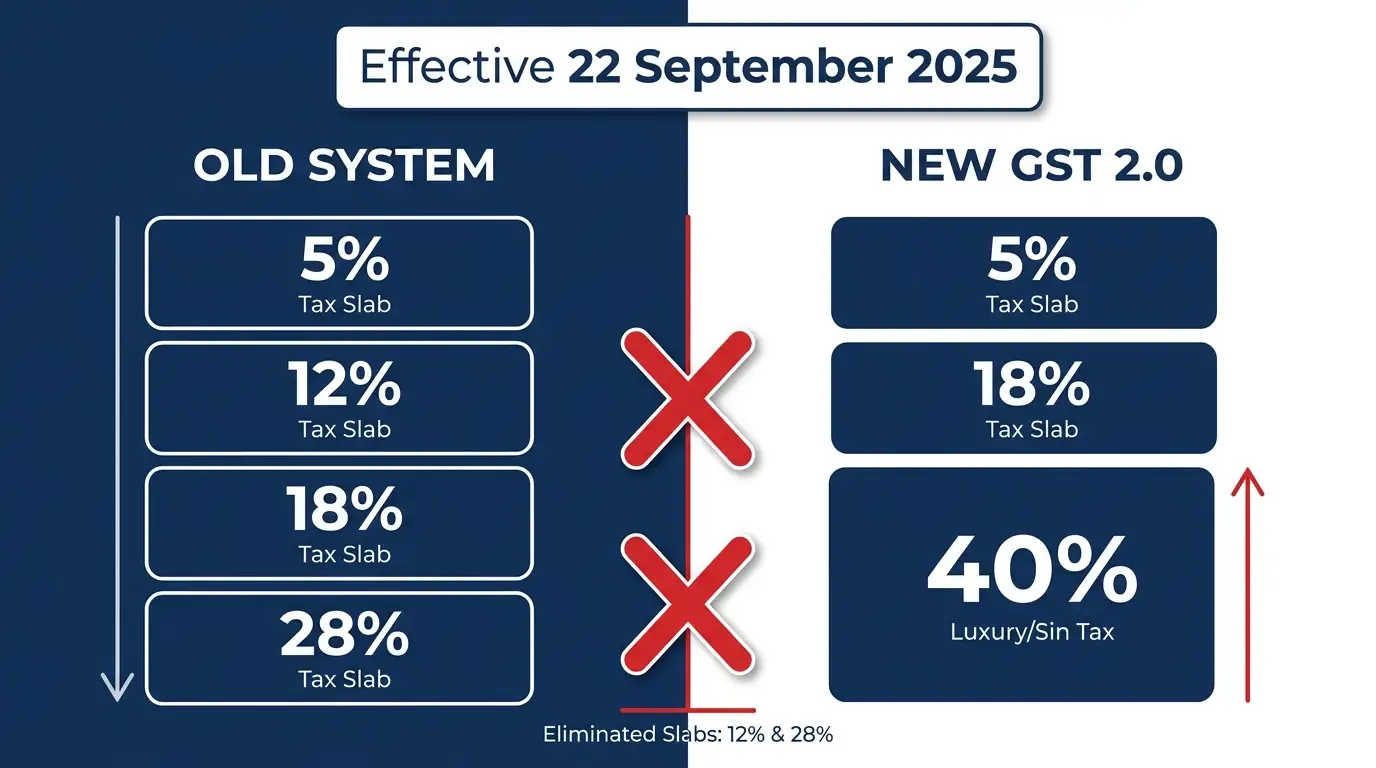
From 22 September 2025, India runs on a three-slab GST structure: 5%, 18%, and 40%. The 12% and 28% slabs are, for most practical purposes, abolished.
The New Rate Structure What It Looks Like Now
Before diving into sector-specific changes, here is the overall architecture:
Slab | Coverage | Purpose |
|---|---|---|
0% (Nil) | Essential staples, life-saving medicines, individual health/life insurance | Protect basic needs from tax burden |
5% | Mass-consumption goods, essential services, agricultural inputs | Keep essentials affordable |
18% | Standard goods and services, electronics, most B2B services | Main revenue slab |
40% | Sin goods, luxury items, demerit goods | Discourage harmful consumption, tax luxury |
What happened to the items that used to sit in 12% and 28%?
99% of items in the 12% slab moved to 5% the remaining 1% moved to 18%
90% of items in the 28% slab moved to 18% the remaining 10% moved up to 40%
The net result: GST rate cuts on approximately 375 items across categories.
What Got Cheaper Category by Category
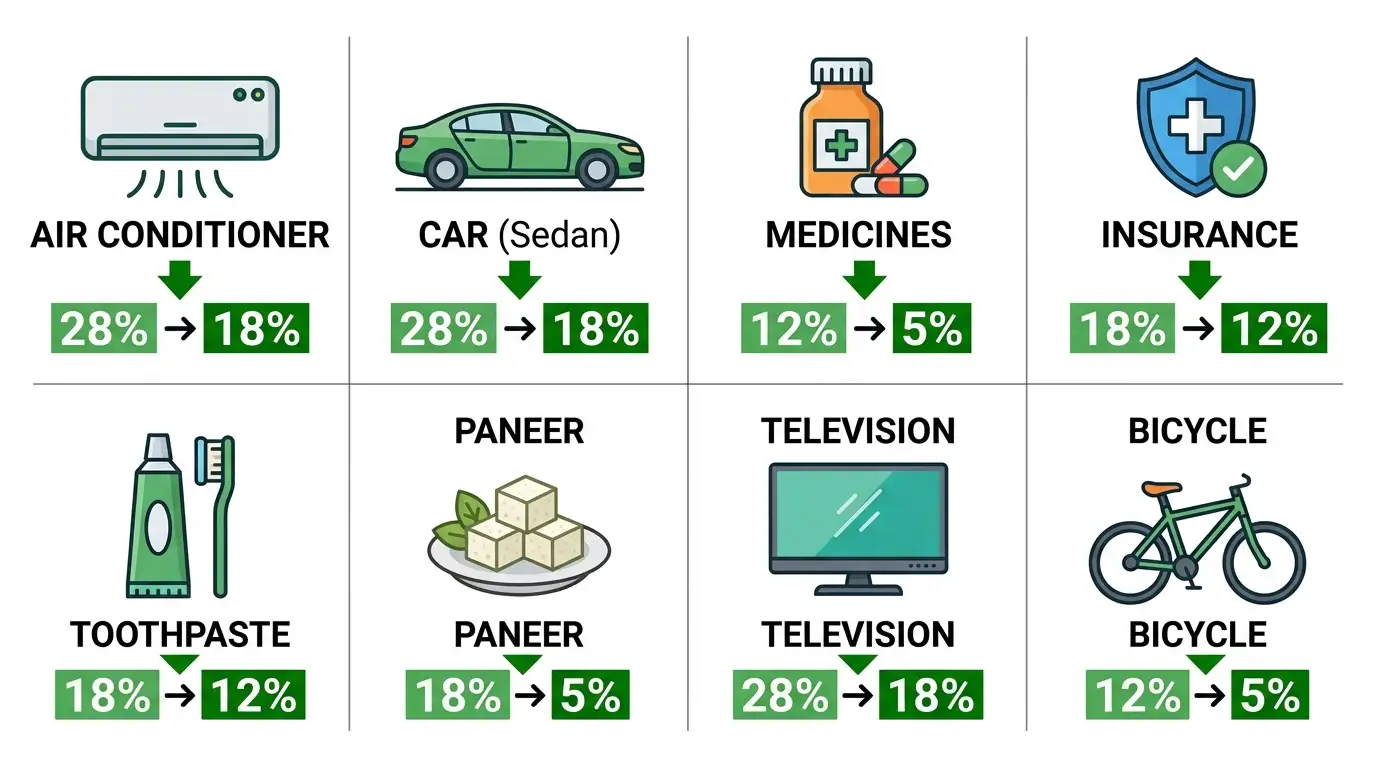
Food and Household Essentials
This is where the most visible consumer relief landed.
Item | Old Rate | New Rate |
|---|---|---|
UHT milk, pre-packaged paneer, chena | 5% | 0% (Nil) |
All Indian breads roti, chapati, paratha | 5% | 0% (Nil) |
Pizza bread, ready-to-eat chapatis | 5–12% | 0% (Nil) |
Butter, ghee, condensed milk, cheese | 12% | 5% |
Packaged namkeens, bhujia, chips, pasta | 12–18% | 5% |
Sauces, ketchup, jams, soups | 12–18% | 5% |
Dry fruits almonds, cashews, pistachios | 12% | 5% |
Coffee (roasted), tea | 5% | 5% (unchanged) |
The Amul and Mother Dairy price cuts that happened in late September 2025 were a direct result of these GST changes both companies passed on the benefit on paneer and ghee within two weeks of the notification.
Healthcare and Medicines
Item | Old Rate | New Rate |
|---|---|---|
Individual health insurance premium | 18% | 0% (Nil) |
Individual life insurance premium | 18% | 0% (Nil) |
33 life-saving medicines (incl. Onasemnogene, Daratumumab, Alectinib) | 12% | 0% (Nil) |
All other medicines and drugs | 12% | 5% |
Medical devices thermometers, glucometers, oxygen kits | 12% | 5% |
Bandages, diagnostic kits | 12% | 5% |
Spectacles and lenses | 12% | 5% |
The health insurance change is the one that generated the most public attention. A ₹20,000 annual health insurance premium used to carry ₹3,600 in GST. Under the new structure, that GST goes to zero. For a family of four with adequate health coverage, this is a real saving not a rounding error.
Personal Care and FMCG
Item | Old Rate | New Rate |
|---|---|---|
Soap, shampoo, hair oil | 18% | 5% |
Toothpaste, toothbrush | 12–18% | 5% |
Shaving products, talcum powder | 18% | 5% |
Bicycles | 12% | 5% |
Stationery notebooks, pens, erasers | 12% | 0–5% |
FMCG companies anticipated a 15–20% volume surge in Q3 and Q4 of FY 2025-26 based on these changes, driven by rural demand where personal care penetration is price-sensitive.
Electronics and White Goods
Item | Old Rate | New Rate |
|---|---|---|
Air conditioners | 28% | 18% |
Refrigerators and dishwashers | 28% | 18% |
TVs and monitors above 32 inches | 28% | 18% |
Washing machines | 28% | 18% |
Cement | 28% | 18% |
A mid-range split AC that cost ₹40,000 before GST carried ₹11,200 in GST at 28%. At 18%, that becomes ₹7,200. The ₹4,000 saving was largely passed on by major brands Voltas, Daikin, and Blue Star all announced price revisions within the first two months.
Automobiles
Category | Old Rate | New Rate |
|---|---|---|
Small cars petrol ≤1200cc, diesel ≤1500cc, length ≤4 metres | 28% | 18% |
Two-wheelers engine up to 350cc | 28% | 18% |
Buses, trucks, three-wheelers, ambulances | 28% | 18% |
Auto parts and components | 28% | 18% |
Maruti Suzuki announced price reductions of ₹40,000–₹75,000 on their small car lineup in the first week of October 2025. For the first time since GST was introduced, buying a Maruti Swift or a Honda Amaze became meaningfully cheaper due to tax policy, not a discount scheme.
Construction and Infrastructure
Item | Old Rate | New Rate |
|---|---|---|
Cement | 28% | 18% |
Marble and granite blocks | 12% | 5% |
Sand-lime bricks | 12% | 5% |
Bamboo flooring and packing materials | 12% | 5% |
The cement change alone has significant downstream effects for affordable housing and infrastructure projects. Contractors who locked in project bids before September 2025 effectively got an input cost reduction of 10 percentage points on cement.
What Got More Expensive The 40% Slab
The new 40% slab is where the government made a clear policy statement: luxury consumption and harmful goods will be taxed more heavily, not less.
Category | Old Rate | New Rate |
|---|---|---|
Tobacco, cigarettes, cigars | 28% + cess | 40% |
Pan masala and gutka | 28% + cess | 40% |
Aerated beverages and energy drinks | 28% | 40% |
Luxury cars petrol >1200cc, diesel >1500cc | 28% + cess | 40% |
Motorcycles above 350cc | 28% | 40% |
Yachts, private aircraft, racing cars | 28% | 40% |
Online gaming and betting | 28% | 40% |
Casino and race club admissions | 28% | 40% |
If you are in the business of selling any of these products, your pricing model required adjustment from 22 September 2025. Suppliers who did not update their billing systems in time have been issuing invoices at 28% creating an ITC mismatch for their buyers who are trying to claim input credit at the correct 40% rate.
The Business Impact Nobody Is Talking About Compliance Risk
Most articles on GST 2.0 focus on what got cheaper. That is the consumer story. The business story is different and more urgent.
When rates change, three things need to update simultaneously in your business: your product master in your billing or accounting software, the HSN codes you declare on invoices, and your GSTR-1 and GSTR-3B filing.
If any of those three are out of sync with the new rates, you have a compliance gap. And compliance gaps in GST show up in one of two ways: a mismatch notice from the department, or an ITC rejection for your buyer.
Here is a scenario that has played out across dozens of businesses since October 2025:
A distributor was selling ACs to retail stores. His billing software still had the HSN code mapped to 28%. His invoices went out at 28%. The retailer paid the higher amount and claimed ITC at 28% on their GSTR-3B. The GST portal flagged a mismatch the supplier's GSTR-1 showed 28% but the correct rate was 18%. The retailer's ITC got blocked. The distributor received an advisory notice. Both spent two months resolving it.
The fix was simple. The preparation was not done in time.
Use the SmartGST GST Rate Checker 2026 to verify the current applicable rate for any product category before issuing an invoice.
Sector-by-Sector Business Impact
FMCG and Retail
Rate reductions on soaps, shampoos, toothpaste, packaged foods, and namkeens mean your selling price can drop while your margin stays the same or you can hold the price and absorb higher margins. Either way, demand is expected to rise. The compliance task is updating your product master and ensuring HSN codes in your accounting software reflect the correct 5% rate for items that moved from 12% or 18%.
Pharmaceuticals and Healthcare
The biggest change here is on insurance and medicines. If you sell medicines, your input costs (raw materials, packaging) may have moved to lower slabs, improving your working capital on ITC claims. If your product was at 12% and is now at 5%, update your invoices immediately. Continuing to charge 12% on a 5% item is an excess collection of tax which creates a liability to refund or adjust.
Automobile Dealers
Your margin structure changes with a 10-percentage-point rate cut on small cars and two-wheelers. If you had already communicated showroom prices before 22 September 2025, those prices need revision. More importantly, your accessories and spare parts billing needs a separate HSN rate check not all auto parts moved uniformly.
Real Estate and Construction
Cement at 18% instead of 28% reduces your input cost significantly. But your output the flat or commercial space you are selling carries its own GST at a rate determined by whether the project is affordable housing or otherwise. Check whether your composite supply rate changed and whether ITC on new-rate inputs flows correctly into your return.
Textile and Apparel
The sector has been through inverted duty structure problems for years. GST 2.0 addresses some of these apparel priced above ₹2,500 now sits at 18%, while basic apparel below that threshold stays at 5%. If you manufacture at multiple price points, your rate classification per SKU needs a detailed audit.
IT Services and Software
Largely unchanged at 18%. Your SAC codes and billing structure probably do not need a full revision but verify if any bundled product-service offerings include items that changed rates. A SaaS product bundled with hardware, for instance, may need component-wise billing to apply the correct rates.
Five Actions Your Business Must Complete Right Now
1. Audit your product and service rate mapping
Pull a list of every HSN and SAC code your business uses for invoicing. Cross-check each against the current rate applicable under GST 2.0. Use the SmartGST HSN Finder to check codes and their current applicable rates.
2. Update your accounting or billing software
If you use Tally, Zoho Books, QuickBooks, or any ERP log in and update the GST rate mapped to each product code. Most major software providers pushed automatic updates in September–October 2025, but verify that your specific product codes were correctly remapped.
3. Check your GSTR-2B reconciliation for the transition period
The months of September 2025, October 2025, and November 2025 are high-risk for ITC mismatches. Some suppliers updated rates in September but continued old billing formats. Use the SmartGST GSTR-2B Reconciliation Tool to identify mismatches between what your suppliers declared and what you claimed.
4. Verify your ITC eligibility on new-rate inputs
When input rates drop (e.g., your raw material moved from 12% to 5%), your ITC per unit also drops. This is not a loss it is a rate reduction. But if your accounting system still records input ITC at the old rate, your books will show excess ITC credits that do not exist. The SmartGST ITC Eligibility Checker can help you verify what is claimable.
5. Review your customer pricing and communicate clearly
If your product got cheaper due to GST 2.0 and you have not passed on the benefit, you may attract anti-profiteering scrutiny. The National Anti-Profiteering Authority (NAA), while less aggressive than in earlier years, still processes complaints. Document your pricing decisions whether you passed on the benefit, absorbed it into margins, or reinvested it with clear reasoning.
The HSN Code Audit More Critical Than You Think
Here is something that does not get covered enough: GST 2.0 did not just change rates. It also released a new HSN Code Guidebook on 20 September 2025, prepared by DPIIT in collaboration with 31 Ministries.
This guidebook allocates 12,167 HSN codes across government departments, creating a unified classification reference. For many businesses, this means that the HSN code they have been using since 2017 may have been reclassified not just rate-changed, but moved to a different chapter entirely.
Incorrect HSN codes on invoices attract penalties under Section 125 of the CGST Act up to ₹25,000 per instance. More practically, wrong HSN codes create ITC disputes for your buyers, which damages business relationships.
Run an HSN audit before your next GSTR-1 filing. The SmartGST HSN Finder lets you search by product name and returns the current applicable HSN code, the correct rate, and whether the code falls under any exemption notification.
GST 2.0 in Numbers A Quick Summary
Metric | Number |
|---|---|
Date of effect | 22 September 2025 |
GST Council meeting | 56th, 3 September 2025 |
CBIC notifications | 09/2025 to 17/2025 |
Items that got cheaper | ~375 |
Items in 12% slab moved to 5% | ~99% |
Items in 28% slab moved to 18% | ~90% |
New 40% slab — items covered | Luxury cars, tobacco, aerated drinks, online gaming |
Expected compliance savings per MSME | ₹30,000–₹1,00,000 per year (fewer disputes) |
GST classification disputes expected to fall | ~40% (NIPFP estimate) |
Tools to Navigate GST 2.0 All Free on SmartGST
These are the specific tools that help you stay compliant under the new structure:
GST Rate Checker 2026 → Enter your product category or HSN code and get the correct current rate. Updated for all September 2025 notifications.
HSN Code Finder → Search by product name to find the correct 4, 6, or 8-digit HSN code and the applicable GST rate under GST 2.0.
GST Calculator → Calculate CGST, SGST, and IGST on any amount at 5%, 18%, or 40% rates. Reverse calculation also available.
GSTR-2B Reconciliation Tool → Identify ITC mismatches from the transition period (September–November 2025) before they trigger a notice.
ITC Eligibility Checker → Verify which of your input purchases qualify for ITC under the current rules.
ITC Reversal Calculator → If you need to reverse ITC on goods that moved to exempt or nil-rated categories, this calculates your exact reversal liability.
Composition Scheme Calculator → Model whether staying in the composition scheme makes sense given the new rate structure.
Related Reading on SmartGST
Understanding GST 2.0 rates is the foundation. These guides take you deeper into specific compliance areas:
How to File GSTR-3B Correctly 2025-26 Guide → GST 2.0 changed your output tax rate. Make sure your GSTR-3B reflects the correct liability from September onwards.
How to Claim a GST Refund → If you overpaid GST at old rates before the transition, you may have a refund claim. This guide covers the process.
GSTAT Appeal Deadline: 30 June 2026 → If your business has a pending GST dispute from the classification battles of the old regime, this deadline matters to you.
GST Late Fee and Penalty Guide 2026 → What happens if you issued invoices at the wrong rate post-September 2025? This covers the penalty structure.
How to Check and Respond to a GST Notice → Rate mismatches from the transition period are generating advisory notices across India. Here is how to respond.
References
56th GST Council Meeting Press Release, 3 September 2025 → PIB
CBIC Notifications 09/2025 to 17/2025 dated 17 September 2025 → GST rate revision notifications cbic.gov.in
Ministry of Commerce, DPIIT HSN Code Guidebook 2025, released 20 September 2025
National Institute of Public Finance and Policy (NIPFP) Fiscal Multiplier Analysis, GST Rate Rationalisation, 2025
GST Council Official Website → gstcouncil.gov.in
CBIC GST Rate Notifications → cbic-gst.gov.in
PM Narendra Modi Address on GST Reforms, 15 August 2025 PIB
Finance Act 2025 Amendments to CGST Act for GST 2.0 implementation
Zoho Books GST 2.0 Rate Update Tables, September 2025 sector-wise rate comparison
India Briefing GST 2.0 HSN/SAC Code Classification Guide, October 2025
Never Miss a GST Rate Change Again
GST rates have now changed once at scale. They will change again the 57th GST Council meeting will add its own revisions, and CBIC notifications follow throughout the year.
If you rely on reading the news to stay current on GST, you will always be two weeks behind. By the time a rate change makes it into a general business article, you may have already issued ten invoices at the wrong rate.
The SmartGST WhatsApp Channel publishes every CBIC notification, GST Council decision, and rate change in plain English within 24 hours of the official release, with a direct explanation of what it means for your business.
No promotional messages. No spam. Just GST updates that matter explained clearly, the day they happen.
Content verified against CBIC Rate Notifications 09/2025 to 17/2025 dated 17 September 2025 and the 56th GST Council Meeting Press Release dated 3 September 2025. Last updated: 5 June 2026. This article is for informational purposes only. Verify applicable rates at cbic-gst.gov.in or consult a qualified CA for product-specific classification advice.