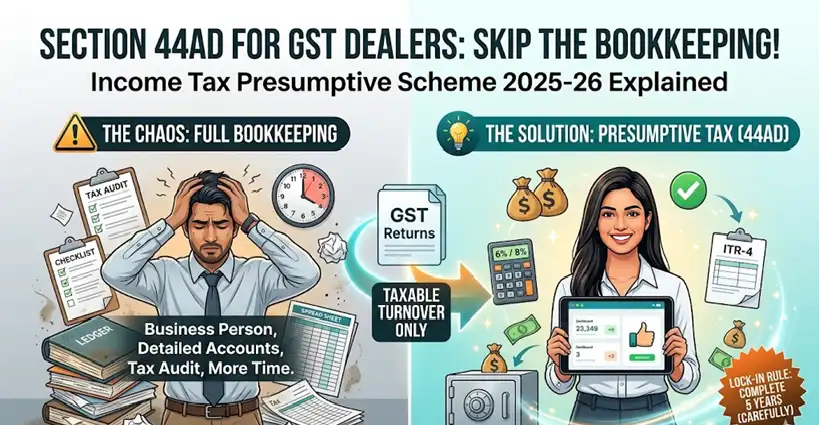
Section 44AD for GST Dealers: Presumptive Tax Explained (2025-26)
You registered for GST because your turnover crossed the threshold. That registration has nothing to do with whether you must maintain full books of accounts for income tax, but most GST-registered traders and freelancers assume the two are connected, and that confusion costs them either unnecessary compliance work or, worse, a missed presumptive taxation opportunity that could have saved hours every month. Section 44AD of the Income Tax Act lets eligible GST dealers declare income at a flat percentage of turnover and skip detailed bookkeeping entirely. This guide explains exactly how it works for a GST-registered business, where GST turnover and income tax turnover diverge, and what the numbers look like with real figures.
Quick Answer: What Is Section 44AD?
Section 44AD is a presumptive taxation scheme that lets eligible resident individuals, HUFs and partnership firms (excluding LLPs) declare business income as a fixed percentage of turnover, 6% for receipts through digital or banking modes and 8% for cash receipts, instead of computing actual profit from detailed books of accounts. It applies if turnover does not exceed ₹3 crore (when at least 95% of receipts are digital) or ₹2 crore otherwise, and it lets you file the simpler ITR-4 form without a tax audit.
Key Facts Table
Item | Detail |
|---|---|
Applicable to | Resident individuals, resident HUFs, resident partnership firms (excluding LLPs) |
Turnover limit, digital receipts 95%+ | Up to ₹3 crore in FY 2025-26 (AY 2026-27) |
Turnover limit, otherwise | Up to ₹2 crore |
Presumptive rate, digital receipts | 6% of turnover |
Presumptive rate, cash receipts | 8% of turnover |
ITR form to file | ITR-4 (Sugam) |
Books of accounts required | No, deemed maintained under the scheme |
Tax audit required | No, unless you declare profit below the presumptive rate and total income exceeds the basic exemption limit |
Advance tax | 100% of the entire liability in a single instalment by 15 March |
Lock-in if you opt out early | Barred from re-entering the scheme for the next 5 assessment years |
New Act reference | Section 58 of the Income-tax Act, 2025 (corresponds to old Sections 44AD, 44ADA, 44AE) |
Why GST Dealers Specifically Need to Understand This
If you are GST-registered, you are already filing GSTR-1 and GSTR-3B every month or quarter, reconciling input tax credit, and tracking due dates. Section 44AD is a separate, parallel relief, it does not touch your GST compliance at all. What it changes is how you report your business income for the Income Tax Act. A trader who maintains spotless GST records can still avoid maintaining a separate set of income tax books, because Section 44AD lets you compute taxable income directly from turnover.
The catch that trips up most GST dealers is assuming GST turnover and income tax turnover are the same number. They are usually not.
GST Turnover vs Income Tax Turnover: The Distinction That Matters
Your GST turnover, as reported in GSTR-1 and GSTR-3B, generally reflects the value of outward taxable supplies, which can include the tax element depending on how it is reported, and certain exempt or non-GST supplies. Your income tax turnover for Section 44AD purposes is, broadly, the net sales or gross receipts of the business, exclusive of GST collected on behalf of the government, since GST collected is not your income, it is a liability you pass on to the tax authorities.
In practice, for most regular trading businesses, the difference is the GST amount itself. If you raised invoices totalling ₹35,40,000 inclusive of 18% GST during the year, your income tax turnover for Section 44AD is closer to ₹30,00,000 (the value before tax), not the GST-inclusive figure. If your accountant or your GST software gives you a single combined number, separate the GST component before applying the 6% or 8% presumptive rate, otherwise you overstate your taxable income.
If you are unsure which figure your accounting software is reporting, run your sales data through our GST Calculator to back out the exact base amount from a GST-inclusive total before you compute presumptive income.
Step-by-Step: How to Apply Section 44AD as a GST Dealer
Confirm your business is eligible. You must be a resident individual, HUF or partnership firm (not an LLP), and your business must not be one of the excluded categories such as goods carriage transport under Section 44AE, or commission and brokerage income, which is specifically excluded from Section 44AD.
Calculate your income tax turnover separately from your GST turnover. Strip out the GST component from your gross receipts to arrive at the figure you will apply the presumptive percentage to.
Check which turnover limit applies to you. If at least 95% of your receipts (by value) came through banking channels, UPI, account payee cheques or other digital modes, your limit is ₹3 crore. If cash receipts exceed 5% of the total, your limit drops to ₹2 crore.
Split your turnover by receipt mode if relevant. You can apply 6% to the portion received digitally and 8% to the portion received in cash within the same financial year, since the scheme allows a blended calculation.
Compute your presumptive income as 6% or 8% of the relevant turnover slice, whichever applies, and add this to any other income you have, such as salary or interest.
Pay advance tax in a single instalment. Unlike regular taxpayers who pay in four instalments, presumptive taxpayers under Section 44AD must pay 100% of their estimated tax liability for the year in one go, by 15 March of the financial year.
File ITR-4 (Sugam) by the due date, declaring your turnover, the applicable rate, and the resulting presumptive income in the dedicated business income schedule, without attaching a profit and loss account or balance sheet.
Decide whether to commit for five years. Once you opt for Section 44AD, the law expects continuity. If you declare profits at or above the presumptive rate for five consecutive years and then opt out, there is no penalty. If you opt out before completing five years by switching to regular books (ITR-3), you cannot re-enter the scheme for the next five assessment years.
Worked Example: A GST Dealer With ₹35 Lakh Turnover
Suppose Priya runs a small electronics accessories trading business, registered under GST, with a turnover for FY 2025-26 of ₹35,40,000 including GST collected at 18%. Almost all her sales go through UPI and bank transfer, with only occasional small cash sales.
Step 1: Strip out GST to get income tax turnover. ₹35,40,000 ÷ 1.18 = ₹30,00,000 (approximately). This is the figure relevant for Section 44AD, not the GST-inclusive total.
Step 2: Confirm eligibility. ₹30,00,000 is well within both the ₹2 crore and ₹3 crore limits, so turnover is not a constraint here.
Step 3: Check the digital receipts test. If 97% of her ₹30,00,000 turnover came through digital modes (₹29,10,000) and 3% was cash (₹90,000), she qualifies for the ₹3 crore limit since digital receipts exceed 95%, and she can apply the lower 6% rate to her entire turnover.
Step 4: Calculate presumptive income. ₹30,00,000 × 6% = ₹1,80,000.
Step 5: Compare with the cash-heavy scenario. If instead 12% of her receipts were in cash, she would fail the 95% digital test. Her turnover limit drops to ₹2 crore (still eligible at ₹30 lakh), but she could no longer claim 6% on her entire turnover. Strictly, the 6% rate applies to the digital portion and 8% applies to the cash portion: (₹26,40,000 × 6%) + (₹3,60,000 × 8%) = ₹1,58,400 + ₹28,800 = ₹1,87,200.
Step 6: File and pay. Priya declares ₹1,80,000 (in the first scenario) as her presumptive business income in ITR-4, adds any other income such as savings account interest, computes her total tax liability, and pays the full amount as advance tax by 15 March 2026, in a single instalment, since presumptive taxpayers do not follow the usual four-instalment schedule.
She maintains no detailed expense ledger, gets no tax audit, and her entire compliance burden for income tax purposes is this one calculation, separate from her ongoing GST filings.
How Section 44AD Compares to the GST Composition Scheme
These two schemes are frequently confused because both offer a simplified, percentage-based alternative to detailed compliance, but they belong to entirely different laws and you can use either, both, or neither, independently.
Feature | Section 44AD (Income Tax) | GST Composition Scheme |
|---|---|---|
Governing law | Income Tax Act | CGST Act, 2017 |
What it simplifies | Computing taxable business income | Computing GST liability |
Turnover limit | ₹3 crore (digital) / ₹2 crore (cash-heavy) | ₹1.5 crore (goods) / ₹50 lakh (services) |
Rate applied | 6% or 8% of turnover, as income | 1% (traders), 5% (restaurants), 6% (services), as GST |
Filing | ITR-4 annually | CMP-08 quarterly, GSTR-4 annually |
Restriction on ITC | Not applicable, this is an income tax scheme | Cannot claim input tax credit |
A trader can be on the GST composition scheme and Section 44AD at the same time, since the two operate independently. A trader can also be a regular GST taxpayer (not composition) and still use Section 44AD for income tax, which is the more common combination for businesses that need to issue tax invoices and want input tax credit for their customers. If you are evaluating whether composition makes sense for your GST filings specifically, our Composition Scheme tool compares your tax liability under regular GST versus composition based on your actual numbers.
When Section 44AD Stops Being the Right Choice
Your actual profit margin is much higher than 6% or 8%. Section 44AD sets a floor, not a ceiling. If your real profit is, say, 15% of turnover, you must declare the higher actual figure, not the lower presumptive percentage. The scheme is most valuable for businesses with thin margins where the presumptive rate is close to or below actual profitability.
Your business is loss-making or has very thin margins. You can declare actual income below the presumptive rate, but only if you maintain books of accounts and get them audited under Section 44AB. This removes the entire compliance benefit of the scheme for that year.
You need to claim specific business deductions. Once you opt into Section 44AD, no further deduction for depreciation, interest, or any business expense under Sections 30 to 38 is allowed separately, since the presumptive rate is treated as already accounting for all such deductions.
Your turnover is approaching the threshold. If you expect to cross ₹2 crore or ₹3 crore partway through the year, plan for the transition to regular books and a tax audit in advance, rather than discovering the requirement after the financial year closes.
The Five-Year Lock-In Rule, Explained With a Timeline
This is the rule that catches the most taxpayers off guard. Once you declare income under Section 44AD for a given assessment year, the law expects you to continue declaring under the presumptive scheme for the next five consecutive assessment years if you remain eligible. If you opt out during that window, for example by switching to ITR-3 and regular books because your actual profit is higher and you want to claim genuine deductions, you lose the ability to use Section 44AD again for the following five assessment years, and during that period, if your income exceeds the basic exemption limit, you must also maintain books and undergo a tax audit.
This restriction applies specifically when you opt out by declaring profits below the prescribed rate. It does not apply if you become ineligible for an unrelated reason, such as your turnover genuinely exceeding the scheme's threshold. In that case, you can return to Section 44AD in a later year once your turnover falls back within the limit, without the five-year bar.
References
Income Tax Department, Government of India, ITR-4 (Sugam) e-filing FAQs: incometax.gov.in
Income Tax Department, Section 44AD text and presumptive taxation provisions: incometaxindia.gov.in
Related tools and guides on SmartGST
Section 44AD Calculator, enter your turnover and receipt mix to get your exact presumptive income instantly
Composition Scheme tool, compare regular GST versus composition for your specific turnover
Full guide: ITR-4, Section 44AD for GST dealers and small business
GST Calculator, separate GST from a tax-inclusive total before computing your income tax turnover
GST aur income tax dono ke updates ek jagah chahiye? Hamara WhatsApp channel join karo, naye rules, deadline reminders aur fresh articles sabse pehle, bilkul free.