
Form 131 Income Tax: The New Form 16A TDS Certificate Explained
Form 131 is the new quarterly TDS certificate for non-salary income under the Income-tax Act, 2025. It replaces the old Form 16A from Tax Year 2026-27 onwards. If a client, bank, or company deducts tax on your rent, professional fees, commission, or interest income, they must issue you Form 131, generated only from the TRACES portal, within 15 days of their quarterly TDS statement due date.
That is the short answer. Now let me walk you through everything else you need to know, because the details around due dates, what the form actually contains, and how to catch errors matter just as much as the definition.
I have been tracking the Income-tax Act, 2025 rollout closely, and one thing I keep noticing is how many freelancers and small landlords still do not know their TDS certificate changed its name. If you are one of them, this guide clears it up completely.
What Is Form 131?
Form 131 is a quarterly certificate that proves tax has been deducted from your non-salary income and deposited with the government. It is issued under Rule 215(1) of the Income-tax Rules, 2026, and its legal backing comes from Section 395(4)(a) of the Income-tax Act, 2025.
Before April 2026, this exact certificate was called Form 16A, issued under Rule 31 of the old Income-tax Rules, 1962, and Section 203 of the Income-tax Act, 1961. The purpose has not changed at all. Only the number, the rule reference, and some formatting details are new.
Who Issues Form 131, and to Whom?
The deductor issues Form 131 to the deductee. In plain terms, whoever pays you and cuts TDS from that payment is responsible for generating and handing you this certificate.
You will typically receive Form 131 if you earn any of the following:
Rent from a company or business tenant
Professional or consultancy fees
Commission or brokerage income
Interest from fixed deposits or other non-salary sources
Contract payments
Technical service fees
Royalties
Dividend income where TDS applies
If you are a freelancer working with three different clients who each deduct TDS on your invoices, you should receive three separate Form 131 certificates every quarter, one from each client. There is no single consolidated certificate that covers multiple deductors.
When Does Form 131 Apply?
This is where I see the most confusion, so let me be precise.
Form 131 applies from Tax Year 2026-27 onwards, meaning income earned from 1 April 2026. For income earned during FY 2025-26 (Assessment Year 2026-27), your deductor still issues the old Form 16A, not Form 131. The two forms are not interchangeable across periods.
If your professional fee TDS was deducted in February 2026, expect Form 16A. If it is deducted in May 2026, expect Form 131.
This creates a short transition window where accountants and businesses need to track both form numbers depending on which financial year the income belongs to. Label your records clearly by year so you do not mix up which certificate applies where.
What Information Does Form 131 Contain?
Form 131 has a lean, two-part structure. Unlike Form 130 (the renamed Form 16, issued for salary), it does not include a full tax computation section. Its only job is to certify that a specific payment had TDS deducted and deposited correctly.
Part A: Deductor and Deductee Details
This section carries the name, address, PAN, and TAN of both the deductor and the deductee, along with the relevant Tax Year and quarter.
Part B: Payment and TDS Summary
This section shows the nature of the payment, the amount paid or credited, the date of payment, the TDS rate applied, the total tax deducted, and the amount deposited. It also includes challan details such as the BSR code and serial number, or Book Identification Number (BIN) details if the deductor is a government entity.
Declaration
The deductor signs a declaration certifying their name, PAN, designation, and confirming the exact amount deducted and deposited with the government. This can be signed digitally or physically.
One practical upgrade in Form 131 over the old Form 16A: it comes with digital verification features and pulls pre-filled data from TRACES wherever possible, which reduces manual entry errors and makes fake certificates easier to catch.
How Is Form 131 Generated and Issued?
Form 131 cannot be typed up manually in Word or Excel and handed to you. It must come from the TRACES portal. Here is the process your deductor follows:
Files the quarterly TDS statement. The deductor submits Form 140 (for domestic non-salary payments, the renamed Form 26Q) or Form 144 (for payments to non-residents, the renamed Form 27Q).
Statement gets processed at CPC-TDS. Once processed without errors, your deductee-wise data becomes available for certificate generation.
Deductor requests the certificate on TRACES. Only certificates downloaded through TRACES carry legal validity. Anything generated outside the portal is not acceptable.
Certificate is signed and issued to you. The deductor signs it digitally or physically and shares it with you before the due date.
If you ever receive a Form 131 that was not generated through TRACES, treat it as invalid and ask your deductor to reissue it correctly.
Due Dates for Issuing Form 131
Form 131 must be issued within 15 days of the due date for filing the corresponding quarterly TDS statement. This deadline is tied to the original statement due date, not the date it was actually filed, so late filing by the deductor does not push back your certificate deadline.
Here is the full schedule for Tax Year 2026-27:
Quarter | Period | TDS Statement Due Date | Form 131 Issuance Deadline |
|---|---|---|---|
Q1 | April to June 2026 | 31 July 2026 | 15 August 2026 |
Q2 | July to September 2026 | 31 October 2026 | 15 November 2026 |
Q3 | October to December 2026 | 31 January 2027 | 15 February 2027 |
Q4 | January to March 2027 | 31 May 2027 | 15 June 2027 |
A deductor who misses these deadlines attracts a penalty of ₹100 per day of delay under the Income-tax Act, 2025. If your Form 131 is overdue, it is worth reminding your deductor, since the penalty clock is running on their side, not yours.
How to Verify Your Form 131 Before Filing Your ITR
Do not treat a Form 131 PDF as automatically correct just because someone emailed it to you. Always cross-check it.
Log in to the income tax e-filing portal at incometax.gov.in
Open your Annual Information Statement (AIS)
Compare the TDS amount in Form 131 with what shows in your AIS and Form 168 (the renamed Form 26AS)
If there is a mismatch, contact your deductor immediately so they can file a correction statement before your return filing deadline
This step matters more than people realize. If the TDS credit in your return does not match what the department has on record, your refund gets delayed or your return gets flagged for scrutiny.
What If Your Deductor Never Issues Form 131?
Check Form 168 first. If the TDS is already reflected there, you can still claim the credit in your ITR even without the physical certificate. If it is missing from Form 168 too, your deductor likely has not filed Form 140 or Form 144 at all, and you need to follow up directly or raise a grievance on TRACES.
Form 131 vs Form 16A: Quick Comparison
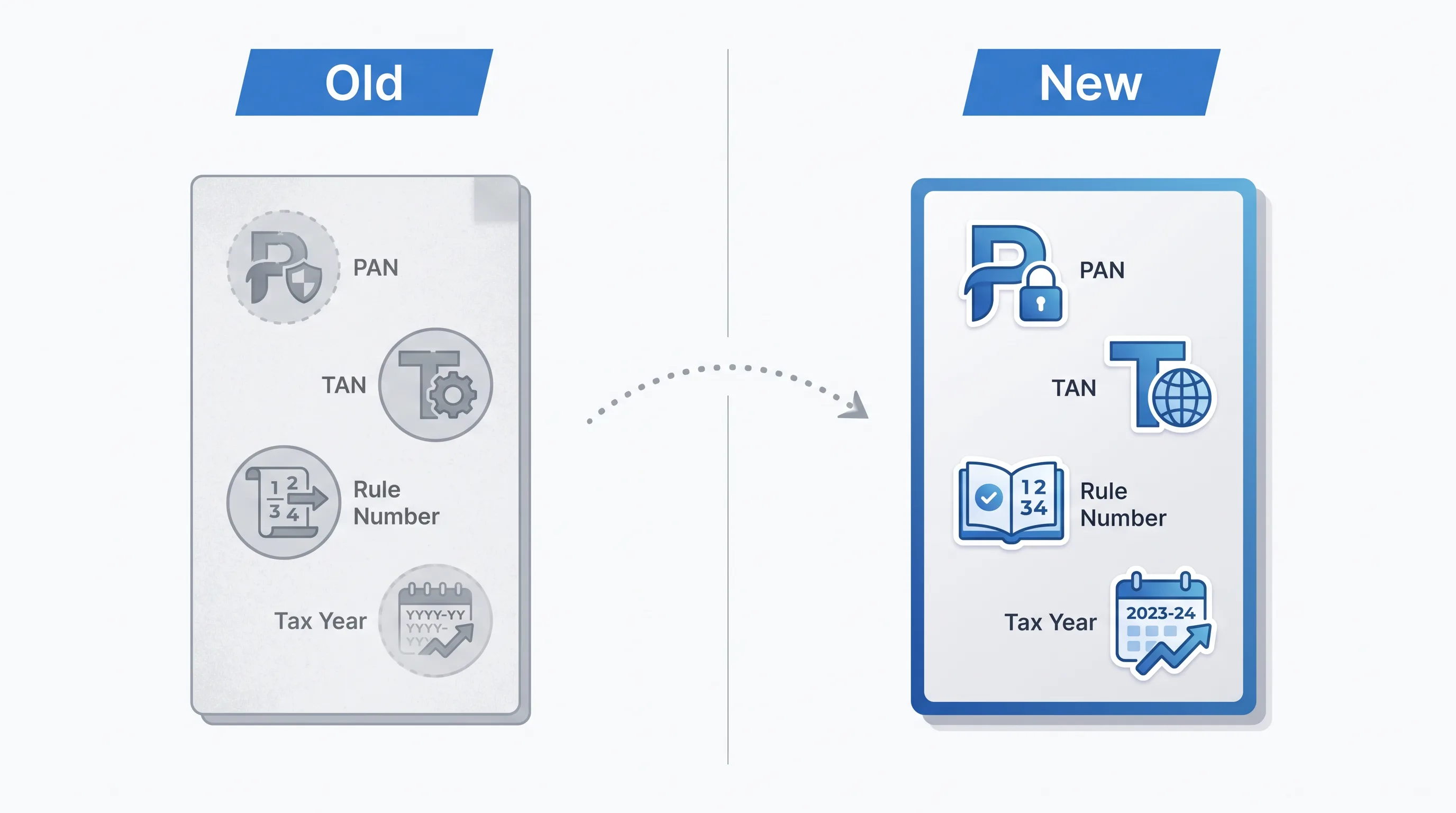
Aspect | Form 16A (Old) | Form 131 (New) |
|---|---|---|
Applicable period | Up to FY 2025-26 | From Tax Year 2026-27 |
Governing rule | Rule 31, IT Rules 1962 | Rule 215(1), IT Rules 2026 |
Legal section | Section 203, IT Act 1961 | Section 395(4)(a), IT Act 2025 |
Terminology | Assessment Year, Financial Year | Unified "Tax Year" |
Portal | TRACES | TRACES |
Frequency | Quarterly | Quarterly |
Pre-filled data | Limited | Enhanced pre-filling from TRACES |
Important Notes
Form 131 replaces Form 16A from Tax Year 2026-27, with no change to its underlying purpose.
It applies to non-salary income such as rent, professional fees, commission, interest, and NRI payments.
The deductor issues it, and you must collect a separate certificate from each deductor.
It is due 15 days after the quarterly TDS statement due date, and late issuance costs the deductor ₹100 per day.
Always verify it against your AIS and Form 168 before filing your return.
For FY 2025-26 income, you still get the old Form 16A, not Form 131.
Related Reading
Confused about how all the other renumbered income tax forms fit together? I cover the complete list of changes, including which forms replaced which, in the New Income Tax Rules 2026 complete guide.
Not sure which form applies to your specific situation, salary, non-salary, property sale, or something else? Use the free Income Tax Form Finder to identify the exact form number you need in seconds.
If you deduct TDS yourself as a business owner and want to double check the applicable rate before you pay a vendor, the TDS Rate Finder tool is free to use and updated for the current rules.
Disclaimer: This article is for reference only. Tax rules and form numbers under the Income-tax Act, 2025 are still being rolled out in phases. Always verify current requirements on the official income tax portal at incometax.gov.in or consult a chartered accountant before making compliance decisions.